The Sentry Who Blocked Camila From Diana’s Archive — Then Revealed Her Secret
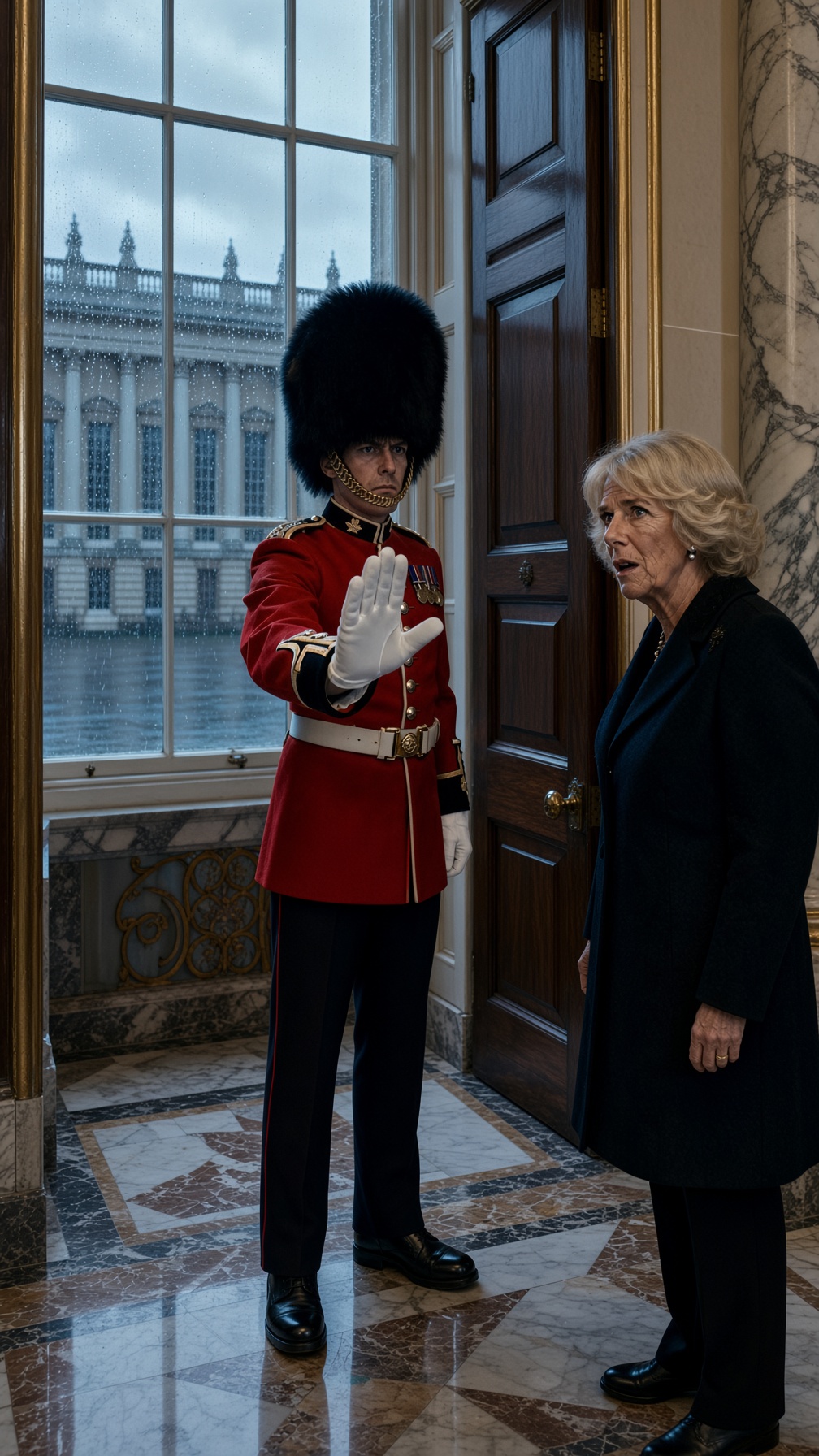
Cold drops struck the tall windows like impatient fingers, while inside the palace, the long marble corridors seemed unusually quiet. Every sound echoed: the distant footsteps of staff, the faint movement of doors, and the sharp click of heels approaching one of the palace’s most secluded areas.
Camila walked with purpose.
She wore a dark coat and maintained the composed expression expected of someone accustomed to public scrutiny. But beneath that calm exterior, something was troubling her.
She was heading toward a room almost no one knew existed.
A private archive.
According to the story, the room contained some of Princess Diana’s most personal possessions—letters, journals, photographs, recordings, and memories that had remained untouched for years.
Camila believed she had permission to enter.
She believed the matter had already been settled.
But when she reached the end of the corridor, she discovered that someone had other plans.
A sentry stood directly in front of the door.
He wore his traditional red uniform and tall bearskin hat. His posture was perfectly rigid. His rifle remained firmly at his side. His face revealed almost nothing.
He looked less like a person and more like part of the palace itself.
Camila approached.
“Excuse me,” she said firmly. “I have permission to enter.”
The sentry did not move.
Camila waited.
Nothing.
She tried again.
“I’m here on official business. Please step aside.”
Still, the sentry remained exactly where he was.
The atmosphere in the corridor changed.
Camila’s assistant stepped forward nervously.
“Perhaps there’s been a misunderstanding,” she said.
Finally, the sentry spoke.
His voice was low and controlled.
“No one enters this room without the prince’s direct order.”
For a moment, Camila looked stunned.
“I have his permission,” she replied.
The sentry slowly turned his head toward her.
“Then he will tell me himself.”
Silence.
Outside, the rain grew heavier.
Camila stared at the man blocking the door.
She was accustomed to people obeying instructions. She was accustomed to protocol, security, and carefully managed palace arrangements.
But this man was refusing to move.
And there was something unusual about the way he did it.
There was no arrogance.
No anger.
Only absolute determination.
Camila looked at the old wooden door behind him.
What was inside?
What had Princess Diana left there?
And why was this sentry willing to stand against anyone who tried to enter?
Then Camila asked the question that changed the entire encounter.
“Who gave you this order?”
The sentry’s expression remained still.
But his answer struck Camila with unexpected force.
“She did.”
Camila froze.
“What do you mean?”
The sentry looked forward again.
“Princess Diana.”
For a moment, Camila seemed unable to respond.
“Princess Diana has been gone for over 20 years,” she whispered.
The sentry finally explained.
Before her death, Diana had supposedly given him specific instructions.
The archive was to remain sealed.
Only certain people were ever supposed to enter.
And Camila was not on that list.
Camila’s assistant immediately objected.
“But those instructions are outdated now. Things have changed. The family has moved forward.”
The sentry looked at her.
“Have they?”
The question was simple.
But it carried enormous weight.
Camila felt her cheeks burn.
She understood what he was implying.
This was not merely about security.
It was about loyalty.
It was about a promise that, according to the story, had survived decades.
Camila looked toward the door again.
“Why you?” she asked. “Why are you the one guarding this room?”
The sentry hesitated.
Then he began to tell his story.
His name was not yet known to Camila.
For years, he had simply been the man standing guard.
But decades earlier, he had been assigned to Princess Diana’s detail.
“I was assigned to her detail in 1995,” he said. “I was young then. Just starting my service.”
His voice became quieter.
“She was kind to me.”
He remembered how Diana had spoken to him.
She remembered his name.
She asked about his family.
She treated him like a person rather than simply another uniform in the palace.
“Most royals don’t do that,” he said.
Camila listened without interrupting.
Then came the part that explained everything.
“One day, she came to me privately,” he said. “She told me she was afraid.”
Afraid of what?
The answer was painful.
Diana feared that after she was gone, other people might try to reshape her story.
They might erase parts of her life.
They might take the things that mattered most to her and turn them into something else.
“She asked me to make a promise,” the sentry said.
His promise was simple.
Protect the room.
Protect the things inside it.
Make certain that only people Diana trusted would have access to them.
“It wasn’t about revenge,” he explained.
“It was about truth.”
Camila’s expression changed.
“And you’ve been doing this for 20 years?”
“Every day.”
The sentry explained that he had personally requested the assignment.
He wanted to remain close to the archive.
No one asked why.
He never explained.
And so, year after year, he continued to stand there.
Rain.
Heat.
Winter.
Political changes.
Family changes.
Public scandals.
Years passed.
But the promise remained.
Camila crossed her arms.
“What’s inside that room?”
The sentry’s expression softened.
“Letters. Journals. Recordings. Things she wanted her sons to have one day.”
He paused.
“Things she wanted the world to know, but only when the time was right.”
Camila swallowed.
“And you think I’ll destroy them?”
The sentry said nothing.
But his silence seemed to answer the question.
Camila turned toward the window.
For years, Diana’s name had remained connected to some of the most painful chapters in the royal family’s history.
Camila thought about William and Harry.
She thought about the life she had built.
She thought about the crown.
And she thought about Diana—the woman who had loved the same man and who, according to the story, had suffered in ways the world could never completely understand.
“I don’t want to erase her,” Camila finally said.
“I just want to move forward.”
The sentry looked at her.
“Then prove it.”
He paused.
“Leave this room alone.”
Those words broke through Camila’s defenses.
She turned around.
Her eyes were wet, though no tears had fallen yet.
“You don’t know me,” she said.
The sentry remained silent.
“You think I’m the villain in this story,” Camila continued. “But you don’t know what it was like.”
She took a breath.
“You don’t know the choices I had to make.”
Her voice became heavier.
“I loved him.”
She continued.
“I loved him before she ever did.”
Camila admitted that she had made terrible mistakes.
But she insisted she was not a monster.
“I’ve spent years trying to earn my place here,” she said. “Trying to be worthy.”
Then came the confession that had apparently lived inside her for years.
“No matter what I do, I’ll always be the other woman.”
She looked down.
“I’ll always be the one who ruined the fairy tale.”
Her assistant tried to comfort her, but Camila pulled away.
“I came here because I wanted to understand her.”
She wanted to read Diana’s words.
She wanted to understand what Diana had been thinking.
Perhaps, Camila hoped, those pages could help her finally make peace with the past.
Then Camila admitted something else.
“You’re right.”
Her voice broke slightly.
“I don’t belong here.”
She turned and began walking away.
Her heels echoed down the corridor.
But before she could disappear, the sentry spoke.
“Wait.”
Camila stopped.
She did not turn around.
“There’s something you should know.”
Camila slowly looked back.
“In one of her letters, Princess Diana wrote about you.”
Everything stopped.
“What did she say?”
The sentry hesitated.
For the first time, he looked uncertain.
He knew he was approaching the boundary of the promise he had made.
But eventually, he spoke.
Diana had written that she understood why he loved Camila.
She had acknowledged that Camila made him laugh and saw parts of him that others did not.
The words were complicated.
Painful.
Human.
Diana had hated Camila for what happened.
But according to the story, she also admitted something unexpected.
She wished she could have been more like Camila—stronger and less fragile.
Camila covered her mouth.
The tears finally came.
They rolled silently down her face.
Then the sentry revealed one more thing.
Diana had written about forgiveness.
Forgiveness, she believed, was not necessarily about forgetting.
It was about releasing the anger.
And she hoped one day she could let go—for her sons and for herself.
Camila asked the question she had perhaps carried for years.
“Did she ever forgive me?”
The sentry shook his head.
“I don’t know.”
He looked toward the door.
“She never finished that letter.”
There was no perfect ending.
No dramatic declaration.
Only an unfinished sentence and two women separated by circumstances neither could completely control.
Camila looked at the door one last time.
“Thank you,” she said.
The sentry gave a small nod.
“It’s my duty.”
Camila walked away.
But the story was not finished.
Three days passed.
Camila did not return to the corridor.
Instead, she continued with her public responsibilities.
Charity events.
Public appearances.
Meetings.
Cameras.
Smiles.
But privately, she could not stop thinking about the sentry.
She could not stop thinking about Diana’s unfinished letter.
Then, on the fourth day, a small package arrived at Camila’s private office.
There was no return address.
Only her name.
Her assistant brought it to her.
“It came by courier,” she explained. “It’s marked private.”
Camila stared at the package.
Then she opened it.
Inside was a worn leather journal.
The edges were old.
The pages were yellowed.
Camila carefully opened the first page.
There, in elegant handwriting, were the words:
“For those who come after me.”
Camila immediately recognized Diana’s handwriting.
Her heart began pounding.
She turned the pages.
There were entries from 1995.
Others from 1996.
And then she reached the final entry.
It was dated only two weeks before Diana’s death.
Camila expected anger.
She expected bitterness.
Instead, she found something far more painful.
Diana had written about loneliness.
Fear.
Doubt.
Her sons.
Her desire to protect them.
She wondered whether the world would remember her as a person or simply as a princess.
Then Camila saw her own name.
She began reading slowly.
Diana wrote about how much time she had spent hating and blaming Camila.
But she had reached a different realization.
According to the story, Diana wrote that Camila had not stolen him from her.
He had never truly belonged to her.
They were both simply trying to survive in a world that had not been built for them.
Then came the sentence that devastated Camila.
Diana wondered whether, in another life, the two women might have been friends.
Camila closed the journal.
Tears streamed down her face.
She pressed the book against her chest and began to sob.
Her assistant rushed to her side.
“Your Majesty, are you all right?”
Camila could not answer.
She wasn’t.
Not completely.
Later that evening, she returned to the corridor.
The sentry was there.
He seemed unsurprised.
“You sent this to me,” Camila said, holding up the journal.
The sentry nodded.
“I thought you should read it.”
“Why?”
“I thought you didn’t trust me.”
“I don’t,” he answered honestly.
Then he added:
“But she did.”
The journal, he explained, was meant to be shared.
Diana had written it for people who needed to hear her story.
And perhaps Camila needed to hear it more than anyone.
Camila asked what she should do with it.
The sentry gave her an answer.
She could not change the past.
Nobody could.
But she could honor Diana’s memory.
She could make sure Diana’s sons knew the truth.
That their mother loved them.
That she was human.
Flawed.
Beautiful.
Real.
Camila looked at the journal.
“What happens to the archive?”
“It stays sealed,” he replied.
“Until William and Harry are ready.”
That was Diana’s wish.
But the journal was different.
She wanted that story to be shared.
Camila asked if she could keep it.
The sentry eventually agreed.
But he made her promise something.
One day, she would give it to Harry.
Camila agreed.
Months passed.
The journal remained in her private drawer.
She read it often.
Sometimes late at night.
Sometimes before beginning another demanding day.
And each time she read it, she discovered something new.
Slowly, Diana stopped being a figure from old headlines.
She became a woman.
A mother.
A daughter.
A young girl who had entered royal life at 19 and struggled beneath its expectations.
Camila began changing.
She spoke more about causes Diana had cared about.
She visited shelters for women escaping difficult situations.
She supported charitable work connected to vulnerable people.
The public noticed.
Some praised her.
Others questioned her motives.
But Camila no longer seemed concerned with proving herself.
She was doing what she believed was right.
Then, one spring evening, William called.
“Camila,” he said.
His voice was serious.
“I need to speak with you.”
The next morning, William arrived at Kensington Palace.
He came alone.
No elaborate entourage.
No unnecessary ceremony.
He sat with Camila in a drawing room.
Tea was served.
Neither touched it.
“I’ve been thinking about my mother,” William said.
He admitted that he had known about the archive for years.
But he had never been ready.
He feared seeing his mother’s pain recorded in black and white.
Now, however, he was ready.
Camila knew what she had to do.
She reached into her bag.
She pulled out Diana’s journal.
“This belonged to your mother.”
William took it carefully.
When he saw the handwriting, his eyes filled with tears.
“Where did you get this?”
Camila told him everything.
The sentry.
The door.
The promise.
The journal.
The unfinished letter.
William listened silently.
Then he looked at Camila.
“Thank you.”
She lowered her eyes.
“I never wanted to hurt her.”
William nodded.
“I believe you.”
Those words meant more to Camila than he could know.
Then William asked a question.
“Will you come with me to the archive?”
Camila hesitated.
But William insisted.
“I need someone there who understands.”
Together, they walked through the palace.
Portraits watched them from the walls.
The gardens lay beyond the windows.
And finally, they reached the corridor.
The sentry was still there.
But when he saw William, his expression changed.
“Your Highness.”
William stopped in front of him.
“I’m ready.”
The sentry looked at him for a long moment.
Then he looked at Camila.
She gave him a small nod.
The sentry stepped aside.
William placed his hand on the door.
He took a deep breath.
Then he opened it.
The archive was small.
Quiet.
Sunlight entered through one window.
Boxes stood neatly on shelves.
A desk occupied one corner.
Photographs sat on top.
Diana with William.
Diana with Harry.
Diana laughing.
Diana looking peaceful.
William walked slowly toward the desk.
He picked up a photograph.
For several seconds, he said nothing.
Camila remained nearby.
“She loved you both so much,” she whispered.
William nodded.
He spent hours inside the archive.
He read letters Diana had never sent.
He listened to recordings she had made for her sons.
He held personal belongings that carried memories of another time.
Camila did not interrupt him.
She simply remained there.
Then William discovered an envelope.
His name was written on it.
It was dated three days before Diana’s death.
His hands shook as he opened it.
He read silently.
When he finished, his expression had changed.
Camila asked what it said.
William looked at her.
“She told me to forgive.”
He paused.
“Not just others. Myself.”
The words were simple.
But they seemed to reach both of them.
“She said carrying anger only makes the pain last longer.”
Camila’s eyes filled with tears.
“She was wise,” she whispered.
William smiled sadly.
“She was human.”
He looked down at the letter.
“And that’s what made her extraordinary.”
As the sun began to set, William and Camila left the archive.
The sentry was still standing outside.
William approached him.
“Thank you,” he said.
The sentry saluted.
“It was my honor, sir.”
Then William asked something unexpected.
“What’s your name?”
The sentry appeared surprised.
For two decades, he had simply been the man standing guard.
A uniform.
A duty.
A silent presence.
Now someone finally wanted to know who he was.
“James,” he answered.
“James Porter.”
William extended his hand.
“Thank you, James.”
James Porter shook it.
His eyes were wet.
That night, Camila sat alone.
She thought about the door.
The sentry.
The journal.
Diana.
And suddenly she understood something.
Diana had never truly been her enemy.
Instead, Diana had become a mirror.
A reflection of everything Camila had been afraid to confront.
Pain.
Loneliness.
Fear.
The need to be remembered.
By honoring Diana, Camila had finally begun to release her own anger.
Two weeks later, William called Harry.
He told him about the archive.
He told him about the journal.
He told him about their mother’s letter.
Then he invited Harry home.
Harry hesitated.
There was still pain between the brothers.
Distance.
Unresolved wounds.
But he agreed.
For their mother.
When Harry arrived at Kensington Palace, Camila met him.
He looked at her carefully.
His expression was guarded.
Camila did not look away.
“Your mother wanted you to have this.”
She handed him a small box.
Harry opened it.
Inside was a bracelet Diana had worn.
There was also a handwritten note.
“Be brave, my darling, and be kind. That’s all that matters.”
Harry’s face crumbled.
The emotion he had carried for so long finally broke through.
Then, unexpectedly, he pulled Camila into a hug.
For the first time, Camila allowed herself to believe that healing might actually be possible.
James Porter watched from the hallway.
He smiled.
His promise had finally been fulfilled.
Diana’s sons had found her words.
They had found her memories.
And perhaps, in finding their mother again, they were beginning to find one another.
That night, after 20 years, James Porter finally left his post.
He looked back at the palace one last time.
The lights of the archive were still on.
Inside, William and Harry were reading, talking, crying, laughing, and remembering.
James felt no sadness.
Only gratitude.
Gratitude that he had known Princess Diana.
Gratitude that he had kept his word.
The rain had stopped.
The storm had passed.
And above Kensington Palace, the stars were shining.
According to this fictional story, the locked door had never been simply a door.
It represented memory.
Loyalty.
Pain.
And the possibility of forgiveness.
The sentry had blocked Camila because he believed Diana’s final wishes mattered more than convenience.
But in the end, that same promise became the reason Diana’s words reached the people who needed them most.
Camila learned that moving forward did not require erasing the past.
William discovered that forgiveness could be part of healing.
Harry received a final message from his mother.
And James Porter finally understood that the promise he had carried for decades had not been in vain.
The archive remained a place of memories.
But the people who entered it were no longer exactly the same when they walked out.
And perhaps that was Princess Diana’s greatest legacy in this story—not a secret, not a scandal, and not a locked room.
It was the possibility that even after years of pain, people could choose to understand one another.
The story itself is fictional and not based on real events, but its emotional message remains powerful: sometimes the hardest door to open is not a physical one.
It is the door to forgiveness.
Disclaimer: This story is fictional and created for entertainment purposes only.
Any names, characters, places, or events are fictitious or used fictitiously.
No real person or organization is intended to be portrayed.