A HERDEIRA DEMITIU o PEÃO no MEIO da COLHEITA… mas DESCOBRIU que só ELE SABIA O SEGREDO DA LAVOURA!
A HERDEIRA DEMITIU o PEÃO no MEIO da COLHEITA… mas DESCOBRIU que só ELE SABIA O SEGREDO DA LAVOURA! 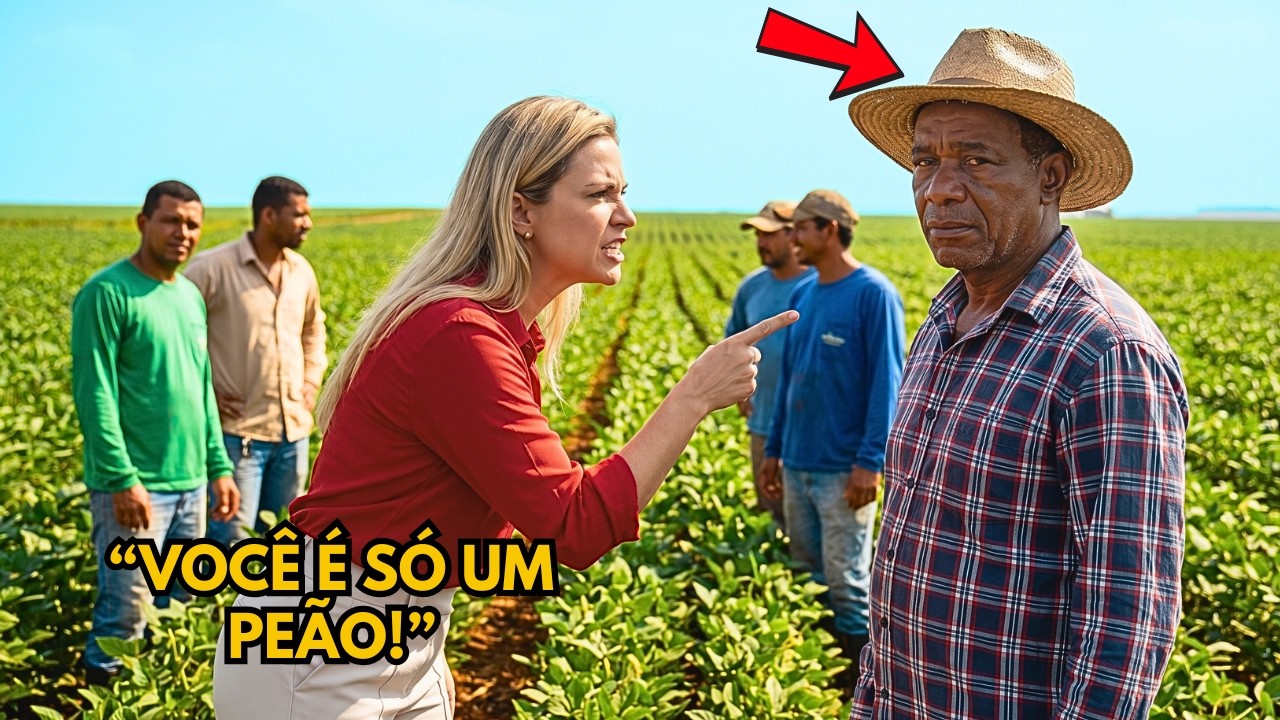
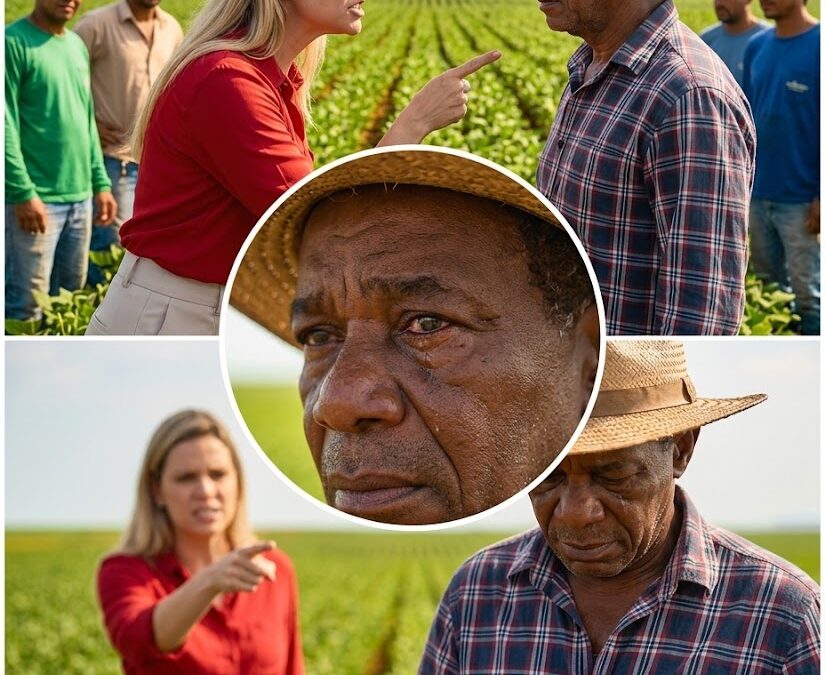
The farmer’s daughter looked at the farmhand in front of everyone and said, “You’re just a farmhand. You haven’t even finished high school. Do you know where the gate is?” He was 52 years old, 23 of them spent in that land. He put on his hat slowly and said something she didn’t forget. Three days later, the farm began to collapse.
And only then did she realize that she had sent away the only man who was keeping everything afloat. The Santa Esperança farm was not just land; it was 40 years of sweat compressed into each hectare. Colonel Augusto Brandão had started from scratch on a piece of dry scrubland that nobody wanted. He bought it cheaply because the land seemed unusable.
He learned from his mistakes, from his older neighbors, from the rain that didn’t come and from the rain that came too much. He lost his harvest, he lost sleep, he lost hair, he gained solid ground. And it gained ground until Santa Esperança became one of the largest producers of soybeans and corn in the entire Mato Grosso region.
An additional R$ 8 million per harvest. Fixed-term contract with the largest cooperative in the state. 340 employees during harvest season, machines worth more than many small towns. Augusto built this with his own hands. Everyone there knew that and everyone respected it. The problem appeared one Tuesday morning when Augusto felt a heaviness in his chest that wasn’t tiredness.
The doctor was direct: a mild heart attack, no serious after-effects, but with an order that allowed no negotiation. Complete rest for 90 days. No farm, no meetings, no fields. Augusto remained silent in the office for a long time. Then he asked in the voice of someone who already knows the answer, but needs to hear it out loud.
And the harvest? The doctor had no answer for that. The harvest needed to be delivered within 60 days. The contract with the cooperative had a penalty clause that Augusto knew by heart. A delay in delivery meant a fine of R$ 1,200,000. It wasn’t the end of the farm, but it was the kind of bleeding that hurts for years. He had two sons who lived in other cities and who never showed any interest in the land.
I had a nephew who knew about cattle, but not about farming. And there was Isabella. Isabela Brandão, 26 years old, graduated in business administration from a private college in São Paulo. The only daughter that Augusto and Dona Neusa raised with all the love in the world, without any contact with the reality of farm life.
She grew up watching her father leave early and arrive late, smelling the earth on his clothes, listening to stories about crops and harvests, as if listening to tales from a distant world. He never set foot on a real field, he never needed to. Augusto called her that same afternoon. Isabela arrived three days later. The car was imported, white, with wheels that had never seen mud in their lives.
The suitcase was a large designer one, with silent wheels that rolled along the asphalt of the entrance, as if that dirt floor were an airport. She was wearing light-colored clothes, her nails were painted in a shade of pink that didn’t match anything else there, and she had the expression of someone taking on a responsibility she had been waiting for for a long time.
The farmhands who were near the headquarters that morning fell silent as she passed by. It wasn’t a silence of respect, it was the silence of someone looking at something and not quite knowing what’s going to happen, but sensing that it won’t be simple. She greeted foreman Gilberto with the firmness of an executive, asked where the office was, and went inside without waiting for an answer.
That first afternoon, Isabela opened the computer, accessed the management systems her father used, and began reading the numbers with the confidence of someone who understands spreadsheets. Operational costs, harvest schedule, contracts in effect. She wasn’t stupid, far from it.
He knew how to read data, he knew how to identify inefficiencies in tables, he knew how to put together reports. What she didn’t know was that those numbers were just the surface of a reality that no system could capture, that the farm functioned not because the processes were good, but because there was a man who arrived before sunrise every day and resolved things before they even entered any spreadsheet.
She had never seen this man before. While she read the reports in the office with the air conditioning on outside in the Mato Grosso heat, her Valmir walked through lot six, with slow steps and attentive eyes. 52 years old, 23 of them in that land. Worn leather hat , boots with marks of dried mud from three different harvests.
He stopped in the middle of the cornfield, bent down, picked up a handful of soil, and rubbed it between his fingers for a few seconds. Then he stood up, looked at the sky, and called one of the younger farmhands. Tell the guy at the east pivot that he needs to reduce the pressure by 15% this afternoon.
The soil here is asking for less. No more. The farmhand wrote it down without questioning. Everyone there knew that when Valmir said something about the land, you wrote it down and did it, not because he told you to, but because he was always right. Until that moment, no one had considered what would happen if he were one day not there to tell them.
Isabela was introduced to Valmir that same night, in a quick meeting that Gilberto organized with the main people in charge of the farm. She greeted each person concisely and then moved on to the points on the schedule. When she came to Valmir’s name on the list and looked at the man in the hat in the chair in the back, she paused almost imperceptibly.
He hadn’t taken off his hat to enter. Not out of disrespect, it was simply who he was. She continued the meeting. He listened to everything in silence, with that calmness that some mistake for indifference, but which is actually just the calmness of someone who doesn’t need to prove anything to anyone.
As he was leaving, one of the older farmhands leaned on Gilberto’s shoulder [clearing his throat] and whispered: “Do you think she knows what this man is worth?” Gilberto looked at the closed office door and did not answer. It was a question that, in the following days, would take on a weight that none of them were prepared to bear. Valmir didn’t have a business card, he didn’t have a fancy job title on a plaque on his door.
What he possessed was something far rarer: 23 years of vivid memories of that land. While Isabela spent the first few days reorganizing spreadsheets and trying to understand the farm’s workflows through the system, her husband Valmir had already solved four problems she didn’t even know existed. On Monday morning, he noticed that the corn in lot 6 had a slightly different color in the middle third, something that only appeared when looking closely, walking slowly, and paying attention.
It was a sign of a silent plague arriving in the third year of that specific soil’s cycle. Anyone unfamiliar with the history of that plot of land wouldn’t see anything. Mr. Valmir saw it, called the person in charge of the sector, and gave instructions before the problem escalated. On Tuesday he woke up at 4 a.m.
because the wind that night had a smell that indicated heavy rain within 48 hours. It wasn’t an app prediction, it was an understanding of the Cerrado biome, learned through years of observation. He brought forward the harvest of a section of plot two, which would not withstand the rain without compromising the quality of the grain.
He organized the team, adjusted the shift, and when the rain finally came two days later, that section had already been harvested and was dry. On Wednesday, the irrigation pivot on the north side gave an intermittent signal that outside technicians were never able to definitively resolve .
The equipment would freeze for a few minutes, then unfreeze itself, and the reports would come back without an accurate diagnosis. Mr. Valmir didn’t need a report. He knew exactly what caused it. a pressure defect at a specific point in the pipeline that I had discovered after 3 years of observing the pattern.
15 minutes, a manual adjustment with my own fingers, and the pivot always returned to its original position. No one had documented this. No one had asked him how he knew. The pivot would jam, Valmir would fix it, and the farm would continue operating. It had been like that for years. What none of them realized amidst that seemingly simple routine was the magnitude of what depended on a single man remaining present.
Isabela noticed something else. She noticed that every time she arrived at a department, the decisions had already been made, that the workers answered her questions but looked at Valmir before acting, that in meetings, when she gave instructions, there was a pause before the answer, and in that pause, the same thing always happened.
Someone was waiting to see if Valmir agreed. She interpreted this as a lack of respect for her authority. Perhaps it was partly true, but the majority was something else. It was the collective instinct of people who had learned to trust those who had never made a mistake on that land. The first direct collision occurred on Thursday.
Isabela was reviewing the harvest schedule and identified what she called a logistical inefficiency in plot 7. Harvesting that plot a week earlier than planned would reduce machine travel costs and free up the team for other areas. On paper, it made sense. It was exactly the type of decision a manager with a background in business administration would make by looking at the data.
She called a meeting and announced the early start date. Mr. Valmir listened, remained quiet for a moment, then said, in the tone of someone giving technical information, that lot 7 had internal moisture above the ideal point, that harvesting before the time would result in grain outside the specification required by the cooperative, that this meant a discount on payment and a real risk of breaching the contractual quota.
Isabela stopped, looked at the chart in front of her, then looked at her Valmir. Do you have any technical report to prove this? I don’t have a report. I’ve had this land for 23 years. The room became very quiet. Isabela did n’t like the answer. Not out of arrogance, because there was no arrogance in that at all .
She didn’t like it because the answer was correct, in a way that she couldn’t refute with data, and that bothered her more than any direct confrontation. She ended the meeting without making a decision about lot 7, but the tension hung in the air, thick and tense, the kind that won’t go away until someone does something about it.
That night, Gilberto stayed in the yard after everyone had left, gazing at the dark horizon of the fields. Valmir passed by him on his way to the truck. Gilberto, Mr. Valmir. The two were silent for a second. Gilberto wanted to say something , but he didn’t. Sometimes we feel like the ground is going to give way before it actually happens, and we stay quiet because we still hope we’re wrong.
Valmir has left . Gilberto stood frozen in the dark. In the following days, Isabela began to circulate more throughout the different sectors. He tried to show presence, firmness. The farmhands responded respectfully, but there was a distance she felt she couldn’t name, as if she were outside of an understanding that everyone else shared.
And she didn’t know, what nobody there knew yet was that she was about to make the decision that would change everything, and that when she made it, no system, no technician hired online, no well-structured spreadsheet would be able to fix what that decision was going to break. The harvest planning meeting was scheduled for Monday at 8 a.m.
Full room. Gilberto, the four sector supervisors, the logistics manager, two shift supervisors, and Valmir, who arrived right on time, as always, hat in hand this time, and sat in the same place as before at the back. Isabela entered with a folder and a decision already made. She opened the revised schedule on the projector screen and got straight to the point.
Lot 7 would be harvested next week, several days before the original deadline. The justification was logistical. Release the large machines to the southern lots before the heat arrives in full force. In the spreadsheet, the numbers added up. The estimated savings were R$ 42,000 in travel and machine time. Gilberto looked at the table.
One of the supervisors started taking notes without questioning. Valmir remained quiet for a few seconds, with the posture of someone carefully choosing their words. Then he said: “Lot seven isn’t ready. If we harvest now, the grain will arrive at the cooperative outside of specifications .
Discount on delivery, risk of quota breach.” Isabela turned to him calmly. You’ve raised this before, but the system data shows that the batch is within the expected harvest window. The system measures what it’s programmed to measure, not what I know about that soil. The silence that followed was different from the others.
It was the silence of someone witnessing something that shouldn’t be happening there. Isabela closed the folder slowly, looked at Valmir for a moment that lasted longer than necessary, and then said with a coldness that didn’t stem from anger, but from something worse: a misguided conviction. Mr. Valmir, I respect the time you’ve spent here, but I have a background in management and I’m not going to make decisions based on the opinion of someone who hasn’t finished high school.
If you don’t know your place on this farm, I know where the gate is. Nobody breathed. The eyes of two supervisors went straight to the floor. The supervisor, who was taking notes, stopped with his pen in mid-air. Gilberto, who was sitting 2 meters away from Valmir, did not raise his head. And Isabela continued as if the previous sentence was just another line on the schedule.
He ‘s fired, tell Gilberto to take care of the funds today. Valmir didn’t react with anger, he didn’t raise his voice, he did n’t say she would regret it, because he wasn’t the type of man who made that kind of threat. He slowly rose from his chair, picked up the hat that was on the table, and ran the brim between his fingers.
Once you have the calm demeanor of someone who has been doing this for 50 years. He looked at Isabela for a second, a moment no one there will forget, and said in a low voice that reached every corner of the room without needing to be loud. The land doesn’t obey diplomas, young lady. He who listens obeys. He turned his back.
The door didn’t slam shut . It hit with the exact weight of something that was finished. And what remained in that room after the sound of his footsteps faded down the hallway was the kind of silence that is not the absence of sound. It’s the presence of something that everyone feels, but no one can name. Isabela looked at those who remained.
Continuing, he turned to the projector. Nobody spoke, nobody disagreed. The meeting continued, but Gilberto, who remained seated until the end with his eyes fixed on the table, listened to every word of the schedule without processing any of it. I was thinking about only one thing. He knew what his Valmir was worth.
I had seen that man save the farm dozens of times without anyone noticing. And he remained silent. He stayed quiet for fear of being next, for fear of losing his own job. This cowardice was going to cost them dearly. He didn’t know exactly how much yet. For the next two days, the farm continued to function, outwardly.
The teams worked, the machines ran, the shifts rotated, but there was a difference that anyone who knew Santa Esperança would feel. The small decisions that Valmir used to make every day, before they became problems, simply weren’t being made. Nobody knew they existed, and nobody knew that nobody was taking them.
The supervisor of the overnight shift started calling Gilberto with questions that had never reached him before. Gilberto answered with what he knew, which was less than he needed to. Two supervisors made conflicting decisions regarding the same section of lot three. One ordered irrigation, the other ordered a pause. And the teams stood there waiting for someone to resolve the contradiction while the heat intensified.
Harvesting of lot 7 began as planned by Isabela. On the afternoon of the second day, the technician in charge of the sector went to the office with an expression that Isabela recognized from a crisis meeting. I brought samples. The grain had a moisture content higher than that tolerated by the cooperative. Exactly what Valmir had said would happen.
Isabela looked at the samples on the table. I didn’t say anything for a while. Estimated loss. The coach hesitated before answering. It depends on how much the cooperative discounts, but we’re talking about an ugly number. She dismissed him, closed the door, and was left alone with those samples and the memory of a phrase that hadn’t left her head since Monday.
The land doesn’t obey diplomas, young lady. He who listens obeys. She still didn’t understand the magnitude of the problem. I still thought it was a one-off setback, something that proper management would resolve with the right technicians. The northern irrigation pivot stopped at 2 a.m.
the following day, and that’s when the true magnitude of the problem began to become apparent. The shift supervisor’s radio rang at 2:18 AM. Then he called again and again. No one answered on the other end, because no one knew for sure who had the authority to make a decision at that hour without going through Gilberto.
And Gilberto was sleeping with his cell phone on silent. The northern irrigation pivot had stopped working. Without irrigation, the corn in that area was exposed to the dry heat of Mato Grosso. One night without water won’t kill the crops. Two is already complicated. Three, the losses start to be counted in numbers with many zeros.
When Gilberto was woken up, almost at 3 in the morning, the problem was already an hour behind schedule. He called the maintenance technician listed in the system. The man answered with a sleepy voice and said he could only come the following afternoon, as he did not answer night calls without an emergency contract.
Gilberto called the second name on the list, voicemail, then the third. He answered the call, went to the farm, opened the pivot’s control panel , looked at it for 20 minutes, and said he needed a specific part that wasn’t in stock and would take three days to arrive. Three days. Isabela was informed at 6 a.m. when she arrived at the office.
She listened to Gilberto’s account with the restrained expression of someone processing data, not yet feeling its weight . He sent for a third technician from a different, more expensive company. This one arrived mid-morning and made the same diagnosis as the previous one. He added that perhaps the piece was even more specific than his colleague had said and presented an emergency budget that Isabela approved without blinking because she had no choice.
While the pivot remained stationary, the corn began to suffer in the silence of the field. On the same day, the soybeans from batch two began to show signs of growth. The grains that Valmir had been closely monitoring in the previous weeks, those he knew needed special attention in the eastern sector’s drainage system, began to darken.
A supervisor [clearing his throat] took a picture and sent it to Gilberto. Gilberto forwarded it to Isabela. She hired an agronomist in the afternoon. The agronomist came, walked around the plot, collected samples, and diagnosed the fungus. He prescribed a fungicide package that cost R$ 40,000 and said there was a good chance it would work.
Isabela asked if he was sure. He said that in agriculture, certainty is a word that isn’t used very often. She provided. The following morning, a second agronomist, recommended by one of the supervisors who was suspicious of the first diagnosis, visited the same plot and said that the problem was moisture in the subsoil, not fungus.
He prescribed a different treatment, also costing R$ 40,000, with the opposite approach. Isabela stood in front of the two reports on the table, one contradicting the other, and made the decision of someone afraid of making a mistake through omission. He approved both, R$ 80,000 in treatments that nobody knew for sure were the right ones.
And things continued to fall apart. In the machinery yard, two supervisors gave conflicting orders regarding the movement of a large combine harvester. One ordered them to advance along the east corridor, the other ordered them to retreat along the same corridor, because there was another machine coming from the opposite direction.
The operator didn’t know who to obey. The radio called to both of them, but there was no coordinated response. The machines collided with a metallic clang that brought everything around them to a standstill for a few seconds. No one was injured, but one of the harvesters was taken out of service with damage to its cutting arm.
Repair cost: R$ 17,000. Actual cost. One less machine at the very moment when they needed them all working the most. In lot six, a tractor entered a section of soil that Mr. Valmir would never allow any machine to access after rain. He knew, from years of observation, that that specific stretch retained water underground for up to four days after rainfall, leaving the ground soft beneath a surface that appeared firm.
The tractor sank up to its axle, it took 6 hours and a winch to pull it out, paralyzing the entire harvesting operation in the sector. Meanwhile, at the end of that day, the cooperative sent out a formal statement. The language was technical and polite, but the message was direct. The delivery schedule was at risk.
If the deadline was not met, the penalty clause would be activated automatically. R$ 1,200,000. Isabela read the statement three times. Then she opened the farm’s financial system , the one she had accessed in the first few days to organize the cash flow. This time I wasn’t organizing anything.
I was trying to understand the extent of the damage. The screen displayed the numbers in red with a clarity that left no room for interpretation. R$ 340,000 in accumulated losses over 11 days due to a stopped pivot irrigation system, contradictory treatments, damaged machinery, a tractor stuck in the mud, out-of-specification grain, and lost operating hours.
11 days. She stared at that number without blinking. Outside the office window, two laborers were talking in voices that weren’t quiet enough. She didn’t have to strain to hear. One of them said his name was Valmir. The other nodded, looked at the ground, and said nothing more. Isabela got up and went to the window.
In the back, plot two had soybeans darkened under the 3 p.m. sun , a machine stopped in the middle, two men around it, not knowing what to do, waiting for an order that never came. Everything was working when she arrived. All of that stopped when she sent away the only man who knew how to play.
She shut down the system, went to the bathroom, locked the door, and stood in front of the mirror for an amount of time that she couldn’t measure afterward. There was no composure there, no argument, only the silence of someone who had destroyed something without knowing it existed and now had to look at the shards with no one left to blame.
But recognizing the damage wasn’t the same as knowing how to fix it. And there was a man 40 kilometers away, repairing a fence in his backyard, who was the only possible answer to that question. Gilberto didn’t sleep that night. He lay in bed staring at the ceiling, burdened by the weight of someone who had carried something too heavy for too long.
He knew what his Valmir was worth. I knew from day one that this resignation was going to be costly. He stayed quiet for fear of losing his job, and now the farm was bleeding. Partly because of what Isabela did, but also because of what he chose not to do. This second part was what kept me from sleeping. The following morning, while Isabela [clearing her throat] tried to coordinate yet another day of patching up old wounds, Gilberto made the decision he should have made sooner.
He left the farm without telling anyone, got in his car, and drove the 40 km to the city where Colonel Augusto was resting. Dona Neusa opened the door. When he saw Gilberto’s expression, he didn’t need to ask anything. She called her husband. Augusto was sitting on the back porch, thinner than before, with the forced patience of a man accustomed to movement now forced to stand still.
Gilberto sat in the chair in front, took off his hat, and told everything. The meeting, the resignation in front of everyone, the phrase that Valmir said before leaving. The pivot irrigation system is stopped, the soybeans are turning brown, the two agronomists have opposing diagnoses, the cooperative’s statement, and the $ 340,000 loss is confirmed.
He recounted the story without sparing any detail, and without sparing himself. He said he knew he had stayed quiet and that he regretted it. Augusto listened to everything without interrupting once. His jaw tightened as Gilberto spoke, but no sound came out. When Gilberto finished, there was a silence of almost a minute. Then, Augusto tried to get up from the chair.
Dona Neusa appeared at the door as if she had been waiting for that exact moment. She placed her hand on her husband’s shoulder with a firmness that wasn’t violence, it was decisiveness. You’re not going anywhere with that kind of heart. I go. Augusto wanted to argue back. She had already picked up the keys. Dona Neusa arrived at the farm without calling beforehand, without sending a message, without any kind of warning .
He entered through the main gate, passed by the headquarters without stopping, and went straight to the field. He walked through the plots with the familiarity of someone who has known that land for decades, because he did. She had accompanied her husband for years before city life took over her time. I knew what I was seeing.
He saw the center standing there with two coaches around him , unable to reach an agreement. He saw that the soybeans from batch two had the wrong color and that the expensive treatments applied had yielded no visible results. He saw poorly positioned machines and teams waiting for orders that were not being clearly communicated.
Then he went to the office. Isabela stood behind the desk, surrounded by reports and notes, with the expression of someone who hadn’t slept properly in days. When she saw her mother enter, something in her posture changed. It didn’t soften, but it wavered for a second before regaining its footing. Dona Neusa did n’t shout, didn’t accuse, she closed the door, pulled up a chair, sat down on the opposite side of the table and remained silent for a moment, looking at her daughter.
Then he spoke in a low voice, as if he didn’t need volume to get deep. Your father and I always protected you from everything: from mistakes, from falling, from contact with harsh things. We thought that was love. He paused. That was the biggest mistake we made. Isabela opened her mouth. Let me finish.
Dona Neusa looked out the window at the field outside. The man you sent away built this farm with his father, without showing up, without asking for credit, without complaining about his salary. Everything you have is because he was here, and you didn’t even know his name properly when he arrived. The silence that followed was the kind that hurts more than any scream.
Isabela stood still. A response was forming, an argument about management, about authority, about what needed to be done. But the argument didn’t come out, because somewhere small and honest inside her, she knew her mother was right. And knowing this for the first time is the kind of thing that pulls the rug out from under you without warning.
On the other side of town, Augusto didn’t just stand around waiting. He picked up his cell phone, called the driver who had been with him since his farm days, and gave an address—not Santa Esperança, but the address of his father Valmir’s house. The doctor had prescribed complete rest.
Augusto nodded in agreement . But there were things a man needed to do personally, and apologizing was one of them . As the car pulled out of the garage, Dona Neusa was still sitting in her office chair at the farm, looking at her daughter, who had run out of arguments. And Isabela, for the first time since setting foot on that land, wasn’t trying to prove anything.
She was just sitting there, her eyes on the floor, discovering the weight of a truth that came too late not to hurt. What she didn’t yet know was what her father was about to do, and that the answer to all of this had a name: Worn- out Hat, and he was 40 km away fixing fences, as if the world hadn’t collapsed. Mr.
Valmir was in the backyard when the car stopped in front of the house. It wasn’t the kind of backyard you see in photos. It was a dirt floor, a wooden fence that he was slowly repairing with his son-in-law, and a mango tree in the corner that provided nice shade in the late afternoon. He heard the car, looked over the fence, and recognized the vehicle before he recognized the man getting out of it.
Augusto Brandão, moving a little slower than before his heart attack, opened the gate himself and entered uninvited, as he had always done in life. But this time there was something different about his posture. It wasn’t the entrance of a boss onto a property, [snoring] it was the entrance of a man who comes with weight. Mr.
Valmir stopped what he was doing. Jenro, who didn’t quite understand what was happening, discreetly disappeared inside the house. Augusto came closer, looked at the half- repaired fence, and looked at his friend Valmir. Do you have coffee? He has. The two went out onto the balcony. Valmir’s wife, Dona Irene, brought two cups without anyone asking and went back inside without asking any questions.
There was something in the air that she recognized as the kind of conversation a man uses when he needs silence around him. Augusto held the cup in his hands for a moment before speaking. He didn’t go straight to the point about the farm, he didn’t go straight to the request. It started somewhere else. When I was 30, there was an older man in the region who understood soil like no one else.
Chico Bento, that’s what everyone called him. I was young, I thought a degree and willpower were enough to get started. He paused. I almost lost everything in the second harvest because I didn’t listen to Chico. I learned that I will never again in my life stop listening to those who know more than I do about what is in front of me. Valmir listened without interrupting.
What was done to you was a disgrace. Augusto’s voice came out firm, but without harshness. In front of the men you yourself raised, a girl who doesn’t know what she does n’t know. The responsibility for this is mine. I raised a daughter who never learned to see the value of what’s around her. And that’s my fault, not hers. Silence. Mr.
Valmir looked at the backyard for a moment. When she spoke, her voice was the same tone as always, without pent-up anger, without resentment waiting to come out. What hurt wasn’t the dismissal, Colonel. We can find a job. What hurt was the disregard, 23 years of that land in my body and being treated as if I were disposable in front of the men I helped to shape.
Augusto didn’t defend himself, he just nodded slowly . So I came here to apologize first, and then I came with a proposal. He placed the cup on the table. I want you to return with a formal position as agricultural operations manager , a registered contract, a salary tripled compared to what you were receiving, and a 2% share of the net profits from each harvest.
Valmir remained quiet. From the kitchen window, Mrs. Irene listened without appearing. “I have one condition,” said Valmir. “The farm is mine to run, without interference from those who don’t understand what they’re doing.” “If this changes at any point, any moment at all, I’m leaving and I’m not coming back.” I accept.
Augusto extended his hand. Seu Valmir looked at it for a second, then shook it. The return to the farm happened the next day and it wasn’t a hero’s entrance. It was tense, with layers that no one pretended did n’t exist. Some older farmhands were visibly relieved. Others, younger ones, stood aside observing.
They had heard different versions of what had happened and didn’t know who to believe. There was a new supervisor that Isabela had hired during the crisis, a 28-year-old with a technical degree [clearing throat] and plenty of energy , who saw Seu Valmir’s arrival as a direct threat to the space he had gained in recent weeks.
Isabela was still on the farm. Augusto had formally removed her management, but she hadn’t left. She stayed, perhaps out of stubbornness, perhaps for something that didn’t yet have a name. In the first hour, when Seu Valmir gave instructions to the foreman of lot two, she appeared and questioned the decision in front of the others.
Seu Valmir stopped, turned slowly to her, She remained silent for a second that lasted longer than it seemed. Then she simply said, “You can call your father.” Pause. Isabela didn’t call him. She opened her mouth, closed it, and stepped back. She left the area without saying anything more. The silence that followed was n’t one of victory, but of something more serious.
It was the silence of a turning point, not of power, but of understanding. For the first time since arriving in Santa Esperança, Isabela Brandão had stepped back not because of orders, not because of pressure, but because she understood she was wrong. And this, small as it seemed, was the beginning of something that would still take time to grow.
Seu Valmir didn’t celebrate; he picked up his hoe and went to plot two. He had work to do, and the land waited for no one. On the second day after his return, Seu Valmir went to plot two, before anything else. He walked slowly through the darkened soybean field, with the farmhands a few steps behind him, observing him in silence. The new supervisor, Lucas, stood a little further away, with his arms crossed and the expression of someone evaluating before deciding what to do. “Sit down.
” Seu Valmir stopped in the middle of the plot, knelt on the ground, opened his hand, took a handful of soil, and slowly rubbed it between his fingers. He stayed like that for a time that seemed too long to anyone watching. Lucas made a low comment to the farmhand next to him. Something about old age and soil. The farmhand didn’t laugh.
Seu Valmir stood up, wiped his hand on his pants, and spoke without looking at anyone in particular. “The problem isn’t fungus, it never was fungus. It’s the drain in the eastern sector that’s been clogged for at least three weeks. The water is accumulating in the subsoil and suffocating the roots. Open the drain, let the soil breathe. 48 hours.
The soybeans will recover on their own.” The agronomist, who had prescribed the fungicide, was present. He said that this was unlikely, that the protocol indicated continuing the treatment. Seu Valmir looked at him with his usual calm. “The protocol was made by someone who studied soil in general. I studied this soil here.
” He picked up the hoe, opened the drain himself in front of everyone, without Hastily, without drama, like someone doing a simple thing that needed to be done. The following hours were filled with silent tension. No one commented much. The agronomist left with the report under his arm and an expression difficult to classify.
The farmhands observed the plot from afar, two or three times a day. Lucas went one of those times alone at the end of the second day’s afternoon and stood at the edge of the plot, looking at the soybeans. When the grains began to regain their color, slowly, from the inside out, exactly as Valmir had said, the silence that swept through the plot was the kind that is worth more than any applause.
Lucas watched for a while, then went to get a hoe and returned to help without anyone asking. No one commented on it, it wasn’t necessary. The pivot, Valmir, solved it the following morning. He went to a tool cabinet in an outbuilding at the back of the workshop. A cabinet that only he knew existed, which held parts and instruments he had collected over the years for exact situations like that.
He took the right part, made the manual adjustment he had learned by Observation after 3 years of monitoring the equipment’s behavior and the system was back. 20 minutes without a technician, without a quote, without a scheduled visit for a few days later. The technician who had a scheduled visit received a cancellation by message that afternoon.
Little by little, the farm resumed its rhythm. The harvest was back on schedule. The cooperative’s notice was answered with a schedule update that satisfied the contract. Isabela went through all this firsthand because Augusto had established the condition before leaving the farm. She would stay not as a manager, but as an apprentice.
She would wake up with the farmhands, accompany Valmir in the field, learn about soil, irrigation, crop cycle, without any privilege of surname during working hours. The first days were hard. She arrived late twice. She complained about the heat, the time, the boots that hurt. She cried from exhaustion one night that she thought no one saw, but Gilberto saw and said nothing, but he was there.
Every day was like that. Valmir didn’t treat her with forced sweetness, nor with harbored resentment. He treated her as he would treat her. Any apprentice. He taught those who were willing, ignored those who weren’t, and didn’t repeat the same thing twice. Isabela quickly learned that complaining had no audience there, so she became quieter, paid attention, and arrived earlier.
The turning point came one early morning during intense rain, three weeks after Valmir’s return. The rain was too heavy, and part of lot six was at real risk of flooding. Valmir was called at 2 a.m. Isabela went along without being asked because she had heard the radio and gotten up. The two worked side by side for almost four hours in the mud, opening the drainage, redirecting the flow, saving what the rain tried to carry away.
There was no hierarchy of surnames there, no diplomas or positions. There were two human beings with their hands in the mud, doing what needed to be done. At a certain point, with the rain on her face and her boots sinking with each step, Isabela stopped for a second and looked at that field at 3 a.m.
, at the plants that resisted, at the earth that received and demanded at the same time, at the man beside her. She had been doing this for 23 years, without anyone ever stopping to tell her what she was worth. She didn’t say anything that night, but something settled inside her that wouldn’t leave. The next day, for the first time, Valmir asked her opinion about a shift adjustment on plot 3.
It was small, a simple decision, but he asked. She answered carefully, without excessive certainty, and he considered what she said before deciding. It was little, but she understood. And knowing that it was understood weighed more than any praise would have . That year’s harvest was delivered on time, with the losses from the weeks of crisis recorded and documented.
Part of the learning process for the entire Brandão family, as Augusto said on a simple afternoon on the Casagre veranda, where he signed Valmir’s contract with two fingers of cachaça and the usual handshake. Gilberto was present. Later, on the edge of the plot, he told Valmir that he regretted having remained silent at the time of the dismissal.
Valmir was silent for a moment, looking at the crop. A man who acknowledges his mistake is worth more than What a man who never makes mistakes. The two remained quiet after that, looking at the soybeans, which this time were perfect. Lucas asked Valmir to teach him what he knew. He received the reply that he could start early tomorrow morning.
In the Casagre kitchen, at the end of the afternoon, Dona Neusa and Isabela were having coffee in silence. The mother said it had taken her a while to let her daughter fall. The daughter said she needed to have fallen sooner. The two remained quiet after that, and that silence was the kind that heals. The last scene of the story happened at the end of a random Tuesday afternoon.
Valmir was standing at the edge of plot two, looking at the soybeans he had saved with his own hands. The crop was golden, dense, exactly as it should be. Isabela arrived and stood beside him. She didn’t speak. He didn’t either. The two looked at the same horizon for a long time. And she, who had arrived at that farm, thinking that inheriting a name was enough, stood there with her feet in the mud and finally understood what every inch of it cost.
Land is inherited, Deeds are inherited, names are inherited, but respect is not. Respect is earned by working with your hands in the same clay as others. And she had wasted too much time, thinking she already had what she still needed to conquer. She didn’t lose the farm that day, she lost respect before and didn’t even realize it.
There are things that don’t appear in reports, don’t go into spreadsheets, and don’t respond to any order. They only work while there’s someone who truly understands, and when that person leaves, the rest crumbles in silence. If this made you think, leave a like and tell me in the comments.
Have you ever seen someone ignore someone who knew and pay the price later? Yeah.