EU OS AJUDEI A CONSTRUIR O TÚMULO AO LADO DE UMA SEPULTURA ANTIGA… ALGO QUE SEMPRE ME ATERRORIZOU
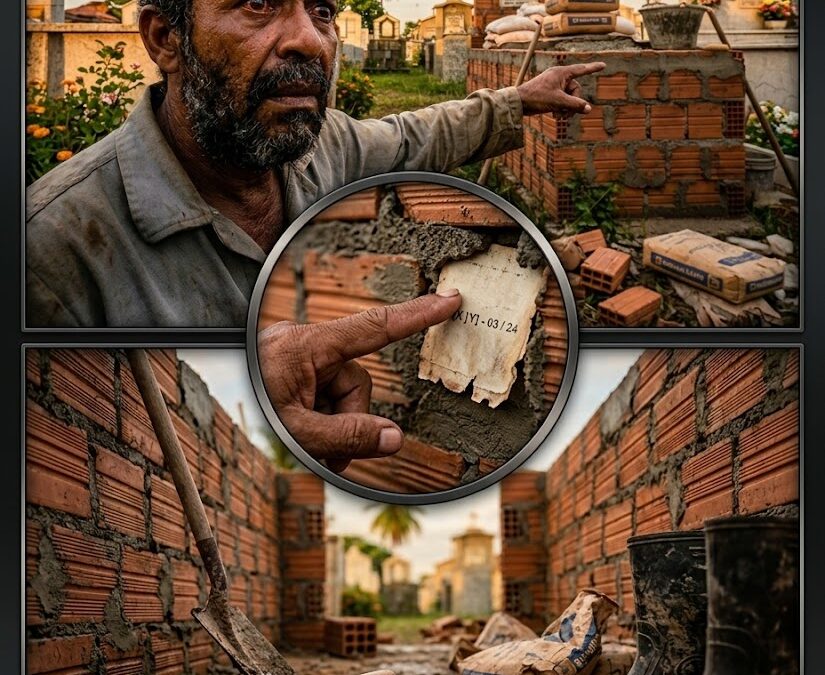
EU OS AJUDEI A CONSTRUIR O TÚMULO AO LADO DE UMA SEPULTURA ANTIGA… ALGO QUE SEMPRE ME ATERRORIZOU 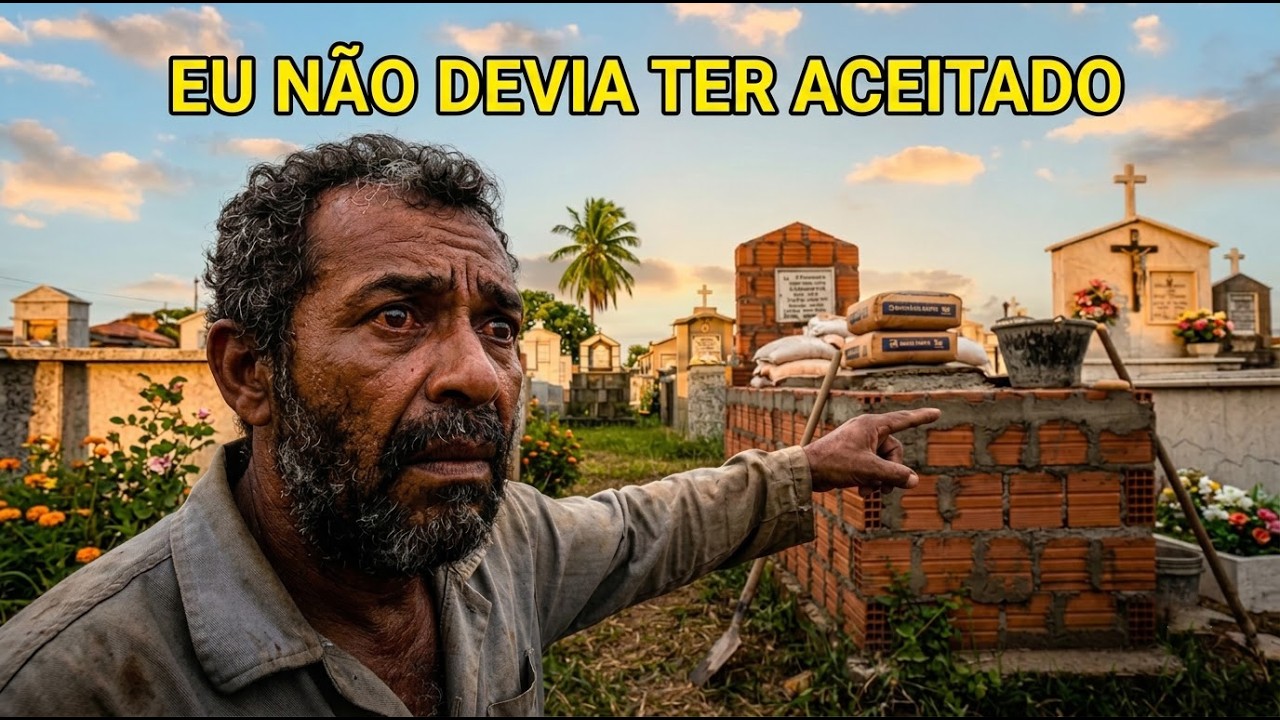
I never liked working in a cemetery. It wasn’t fear of ghosts, nor of those stories that people tell. It was a different feeling, as if that place had its own memory, as if each tomb held something beyond just a body. Even so, I accepted the job. It was just a simple construction, erecting a new grave in an older area of the municipal cemetery.
Quick job, two or three days at most. The problem is that on the very first day I discovered that the artwork was located right next to a tomb I’d known since childhood. A name I grew up hearing at home. A name my grandfather used when he wanted us to go to bed early. When I saw the gravestone, my stomach churned, not because I believed the story, but because it was too much of a coincidence.
I thought about asking to change jobs, making up any excuse, but it was just a tombstone, just a name carved in stone, nothing more than that. That’s what I kept repeating to myself as I unloaded the bags of cement and the tools. But as the day went on, things started happening that were too small to become a problem, but too strange to ignore.
A noise behind me when there was no one around. A tool that fell even though it was standing firmly on its own, the constant feeling that someone was watching every move. By the end of that week, I was no longer afraid of what might be there. I was afraid of what my own mind was creating. My name is Enzo.
I work as a bricklayer’s assistant in a small town in the interior of Bahia called Serra do Umbuzeiro. It ‘s not a big place, nor is it busy. Everyone knows everyone else, everyone knows everyone else’s business. And the municipal cemetery is located in a higher part of the city, almost isolated. I grew up hearing stories about that place.
My grandfather liked to tell the story of how a man named Isaac Ferreira was buried there. He said that Isaac had not been an ordinary person in his lifetime. He said that he walked alone along the roads, that nobody knew where his money came from, and that after his death strange things began to happen near his grave.
When I was a child, that really scared me. But we grow up, start working, and learn to treat these stories as superstition. At least that’s what I thought until I accepted that job. I ‘m not the team’s bricklayer. The person in charge of the construction is Seu José, an experienced, calm man who has already built half the houses in the city.
I just help out, carry materials, prepare dough, and keep the level safe. When he told me that the next job would be to build a new grave in the cemetery, I didn’t like the idea, but I didn’t complain either. It was work. But he didn’t know, or perhaps didn’t remember, that Isaac Ferreira’s tomb was located exactly on that block. I knew.
And the moment I stepped there and saw the name engraved on the tombstone next to the area where we would begin construction, the memory of my grandfather’s stories came flooding back, not as a distant legend, but as something present, physical, too close. Before we continue, if you enjoy stories that are more mind-bending than supernatural, please leave a like, subscribe to the Relatos Obscuros channel, and turn on notifications so you don’t miss future videos.
And tell me in the comments where you’re watching this from right now. I want to know how far this story is going. On the first day of construction, the sun hadn’t even gotten properly warm yet. When we arrive at the cemetery, the Serra do Umbuzeiro usually wakes up slowly, but up there the silence seems heavier.
Seu José opened the padlock on the side gate, as if he were entering any other property. I went in behind him, carrying the tools, trying to act naturally. The area where we would build the grave was in an old block, with tombstones worn by time and names almost erased. Even before putting the bucket down, my eyes automatically searched for the gravestone I remembered from childhood.
I didn’t have to look very far. The name was there, engraved in dark stone, Isaac Ferreira. The date of death was decades ago, but the feeling I had was immediate, as if that tomb had been opened the day before. I didn’t say anything, I just felt my stomach clench as José began measuring the space next to me. The task was simple.
We would raise the concrete base, erect the side walls, and have it ready for enclosure in the following days. Technically it was the same as any other [song] for burial. The problem wasn’t the work itself, it was the proximity. Every time I bent down to align the form or reach for a tool, I felt like I was trespassing on an invisible boundary.
There was no wind, but the trees at the back of the cemetery made a low, steady rustling sound that seemed to accompany every movement. At one point, while I was holding the level, I had the impression of being watched. It wasn’t peripheral vision, nor a bright shadow. It was a physical sensation, as if someone were standing behind me, very close. I’ll turn around quickly.
There was no one there, just rows of ancient tombs and the closed gate in the distance. Mr. José noticed that I was distracted. He asked if I was feeling unwell. I said it was just the heat, even though I knew it was still cool. He laughed and commented that cemeteries only scare people who hear too many stories about them as children.
That caught me by surprise, because he didn’t know about my grandfather, nor the stories I had heard about that place. I continued working, but my concentration was no longer the same. When I went to get water from my backpack, I stopped again in front of Isaac Ferreira’s gravestone . I glanced at the full name, as if checking to see if it wasn’t just a coincidence of surname.
It was the same name I had heard so many times in my childhood, the same spelling, the same combination that, according to my grandfather, should never be mentioned near the cemetery after 6 pm. While preparing the dough, I let it fall. It wasn’t anything serious, but the noise echoed too loudly in that silence.
The sound seemed to spread through the courts as if it had struck something hollow. My heart raced for a second, disproportionate to the situation. Seu José simply picked up the tool and told me to pay attention. I paid attention, but while mixing cement and sand, I started noticing details that would have gone unnoticed before.
A recent crack in the side of the neighboring tomb, marks on the ground that looked like scratches, a subtle difference in the color of the soil around Isaac’s gravestone. Nothing was clearly out of the ordinary. Everything could have a simple explanation. Still, every detail reinforced the impression that this place was not neutral.
When the day ended, the base for the new grave was already ready. We cleaned up the tools and closed the gate, as usual. Before leaving, I looked at the court one last time. The unfinished building cast a long shadow that reached halfway up Isaac Ferreira’s tombstone . For a moment, I had the feeling that the shadow wasn’t coming from the structure we had built, but from the tomb itself next to it.
I blinked, took a deep breath, and dismissed the thought. It was just the late afternoon changing the angle of the light. Even so, as I walked down the cemetery slope with José, I understood that the discomfort wasn’t a passing fancy; it was something that had started there and would probably return the next day.
On the second day, the sun was already high when we returned to the court. The concrete base had dried properly, with no apparent cracks. Everything indicated that it would be a normal day of continuing the work. Still, even before picking up the tools, my eyes automatically sought out Isaac Ferreira’s gravestone .
The name was there, motionless, indifferent. I tried to treat it as a coincidence. Isaac was not a rare name, nor was Ferreira. Serra do Umbuzeiro is small, but surnames are repeated. While José was laying the first rows of paving stones, I became convinced that the discomfort of the previous day had been just old, unresolved nervousness.
The problem was that the more I tried to act naturally, the more aware I became of every noise around me . It was while preparing the mortar that I heard the first different noise, a dry sound, as if something had hit a stone. I raised my head immediately. Mr. José continued working, focused, without reacting.
The noise came again, this time lighter, like a short dragging sound. I walked to the side of the court to check. Nothing out of place, no tools dropped, no animals in sight. The cemetery was empty except for the two of us. When I returned, Mr. José commented that at that time of day the heat makes the concrete crack.
He said it was common to hear small sounds as the material expands. I nodded, even though I knew that the sound I heard didn’t sound like concrete cracking, it sounded like movement. Still, his explanation was too logical to be ignored. Later, while I was holding a board to level the side wall, I felt something touch my shoulder.
It was quick, light, almost like a bump. I’ll turn around right away. There was no one behind me, no low branches, no overhanging structures. Seu José was on the other side of the grave, too far away to have touched me. He noticed my sudden movement and asked what was wrong. I said nothing, just a reflection.
He replied that working while under stress causes the body to react before the mind understands the reason. That annoyed me more than it should have, because deep down the explanation made sense. I was tense from the first minute I stepped in there. The next episode happened around noon. I had left the measuring tape on the edge of the newly erected structure.
As I turned to pick up the bucket, I heard it fall to the floor behind me. The sound echoed once more across the court. The measuring tape had fallen a few centimeters from the base. Seu José looked and said that I had placed it too close to the edge. Perhaps it did, but I clearly remembered leaving it far enough away so it wouldn’t slip.
The ground was dry, there was no slope. Even so, I didn’t argue. I picked up the tool and continued. While I was working, I began to question my own memory. Did I really put it in the center? Or was he already so attuned to his surroundings that any common mistake seemed like the intervention of something invisible? In the late afternoon, the shadow of the new structure once again stretched over the neighboring tomb.
The same scene as the day before, but now clearer. I stood there for a few seconds observing the pattern of light on the floor, trying to understand why it bothered me so much. Mr. José closed the bag of cement and called me to leave. Before leaving, I looked around one more time. Nothing out of place, no movement, no concrete evidence that anything was wrong.
Everything that had happened that day could be explained by carelessness, heat, tension, or simple coincidence. And perhaps that was exactly it. As I walked down the slope to the cemetery, I began to consider a possibility that bothered me even more than any strange noise. Perhaps the problem wasn’t in the cemetery.
Perhaps it was all in my head, fueled by an old story that should never have resurfaced. On the third day, Mr. José was late. He said he would resolve a problem with the delivery of materials and that I could get a head start on organizing the area while he was on his way. I didn’t like the idea of being alone there, but I also did n’t want to seem childish.
I arrived too early; the cemetery was still silent, with the wind stirring up fine dust between the plots. The tomb’s structure already had its walls almost finished. The front part still needed to be lifted. and adjust the finish. As soon as I walked through the gate, I felt that same sensation of being watched, only more intense. There was no one in sight.
Even so, the air felt heavier. Perhaps it was simply the fact of being alone. Perhaps it was a memory. Perhaps it was the story my grandfather repeated so many times when I was a child. The one about the man who said that even after being buried, he continued waiting for someone beside his own grave.
I started working in an attempt to keep my mind occupied. I mixed mortar, aligned blocks, and checked the level. The silence was too absolute. Without the constant sound of José’s tools, any noise took on a new weight. At one point, I heard footsteps on gravel behind me. They were clear, rhythmic, like someone walking slowly. I’ll turn around right away.
Nothing, not even a shadow, not even movement. I stood still for a few seconds, waiting for him to repeat. He didn’t repeat it. I tried to convince myself that it could be some small animal crawling between the tombstones. The problem was that the sound seemed too heavy to be an animal. As I walked back to work, I noticed my hands were sweating, even with the dry wind blowing across the court.
That’s when the strangest thing happened. I was fitting a block together when I felt the structure vibrate slightly under my fingers. It wasn’t a collapse or a malfunction. It was a short, almost imperceptible vibration, but real enough to make me recoil. I took two steps back. The block I was holding slipped and fell to the ground, breaking off one of its edges.
The sound echoed too loudly in the silence. My heart raced. The vibration could have simply been a natural adjustment to the weight of the newly erected structure, the concrete settling. Nothing more than that. But at that moment, my mind wasn’t thinking about physics. He thought of the phrase my grandfather used to say when he wanted to scare us.
Some people just can’t accept being underground. I stepped a few meters away from the grave and stared at the tombstone next to it, Isaac Ferreira. The name seemed more present than ever. I had an irrational urge to check the date again, as if I could prove something to myself. I approached slowly and touched the cold stone with my fingertips.
Nothing happened, no sound, no movement, only the heat of the sun beating down on the light marble. Still, the feeling that I shouldn’t be there grew in an almost suffocating way. For a few seconds, I considered leaving, simply walking out the gate, leaving the tool where it was, and saying later that I felt unwell. That would n’t be a lie. I really was.
The noise that almost made me run came right after. A sharp thud hit me from behind, on the inside of the structure that hadn’t yet been closed. The sound was loud enough to make me turn around immediately. One of the newly placed blocks had shifted slightly, tilting inwards. Perhaps I hadn’t sat down properly.
Perhaps the mortar was wetter than I imagined. Perhaps the previous vibration was a consequence of that. But at that moment, the explanation didn’t come first; fear did. I took a deep breath, tried to stabilize my thoughts, and approached again. I adjusted the block carefully. He returned to the place without resistance.
No invisible force, no proof that anything was happening beyond my own accumulated tension. When I heard the gate creak in the distance and saw José entering through the main avenue, I felt a relief that embarrassed me. He noticed my condition before I even asked anything. He said I looked pale. I only mentioned that a block had given way and that the structure seemed unstable.
He examined it calmly, tapped the sides with a trowel, and concluded that it was the normal settling of the weight. He explained it technically, as he always did. Everything had an explanation, everything had logic. As he spoke, I began to believe again in the concrete reality of things. Still, a part of me knew that if I had stayed there alone for a few more minutes, I might have abandoned the project.
Not because of something I saw, but because of what my own mind was beginning to construct. The near-accident happened in the late afternoon, when the sun was already setting behind the cemetery walls. The front of the grave needed to be closed, and I was holding one of the concrete slabs while José adjusted the base.
The terrain there had a slight slope that I hadn’t noticed before. When I put my weight on the floor to help fit the piece, I felt the ground give way beneath my left foot. It was quick. My body leaned back, the plaque slipped from my hands, and for a second I was sure it would fall on me or plummet straight onto the grave next to it.
Instinctively, I tried to keep my balance and ended up stepping right on the edge of Isaac Ferreira’s grave. The impact caused the structure to vibrate again, more strongly than any previous vibration. It felt like everything was about to collapse. My heart raced as if something had reacted to the touch. I retreated in a disorganized manner, tripping over my own tool.
Seu José caught the sign before it fell completely and shouted for me to pay attention. I could barely hear. I looked directly at the name engraved on the tombstone, as if expecting some kind of answer from there. The mind connected everything in seconds. The grandfather’s story , the matching names, the noises, the vibration.
For a few moments it was impossible to separate the fear from the concrete fact. My breathing became irregular. Cold sweat trickled down his back, even though the heat still hung in the air. Seu José noticed I was out of sorts and told me to sit in the shade. While he finished fitting the piece together, I stared at the tomb next to him.
It was then that something simple, almost ridiculous, broke the tension. The birthdate engraved on the tombstone caught my attention in a different way. I did a quick mental calculation. My grandfather’s stories were about a man who had supposedly died decades before that date. The ages didn’t match, nor did the year .
The coincidence was only in the name, the common name. Isaac Ferreira could exist anywhere. The grave had no connection whatsoever to the story I had carried since childhood. The fear that grew there didn’t stem from some hidden fact; it came from my own automatic association. When I got up to go back to work, the feeling changed. The ground that had subsided was only a poorly compacted area, probably affected by old water infiltration.
The vibration of the structure came from the uneven distribution of weight at the base. The footsteps I heard earlier could have been an echo of distant movement or even the structure itself shifting as it dried. Nothing there indicated presence, only carelessness and accumulated tension. Still, the scare had been real.
If the sign had fallen a few centimeters further ahead, it could have broken my foot or caused a serious accident. The danger existed, but not in the way my mind had imagined. At the end of the day, as we were gathering our tools, I realized that what almost made me abandon the project wasn’t some invisible force.
It was an old fear that I brought with me even before setting foot in that cemetery. The work was completed on a hot Friday, with no wind and no unusual events. The grave was finished ahead of schedule, aligned, sturdy, with the finishing touches that José always insisted on checking twice. I stood there for a few seconds, looking at the tombstone next to me, where the name that had accompanied me all those days was written: Isaac Ferreira.
The old tombstone, worn by time, was no different from the others, no cracks in common, no detail that justified the fear I felt. It was just a name. And there, standing before him, I realized that everything that had happened that week had passed more through my head than through the cemetery.
The noise from the falling tool had an explanation. The shadow I saw was just a change in the light. The wind swirling between the tombstones creates sounds that resemble footsteps when you’re already tense. Seu José never saw anything beyond what was right there. I was the one who carried my grandfather’s stories with me as if they were personal warnings.
I grew up hearing that certain dead people did not rest, that some names should not be repeated at night, that Isaac’s tomb was avoided after sunset. Working there forced me to confront this head-on. There was no curse, there was memory, there was suggestion, and there was the fear that we learn when we are little and never truly question.
When I left the cemetery that last day, I didn’t feel brave, I felt lucid. I understood that the location was never the problem. The name on the tombstone isn’t there either. What scared me was the idea that had been built up over the years, reinforced by whispered stories, as if they were warnings. The grave was finished, the tomb remained there, and I returned home knowing that some hauntings don’t live among the dead, they live in what we carry without realizing it.
This story reminded me of a classic psychological horror film that explores precisely this line between fear and the mind. If you’d like to see the link to the book, it’s in the description.