EX-COVEIROA CONTA : PENSOU QUE FOSSE UMA MÃE REZANDO… MAS AQUILO NO CEMITÉRIO NÃO ERA
EX-COVEIROA CONTA : PENSOU QUE FOSSE UMA MÃE REZANDO… MAS AQUILO NO CEMITÉRIO NÃO ERA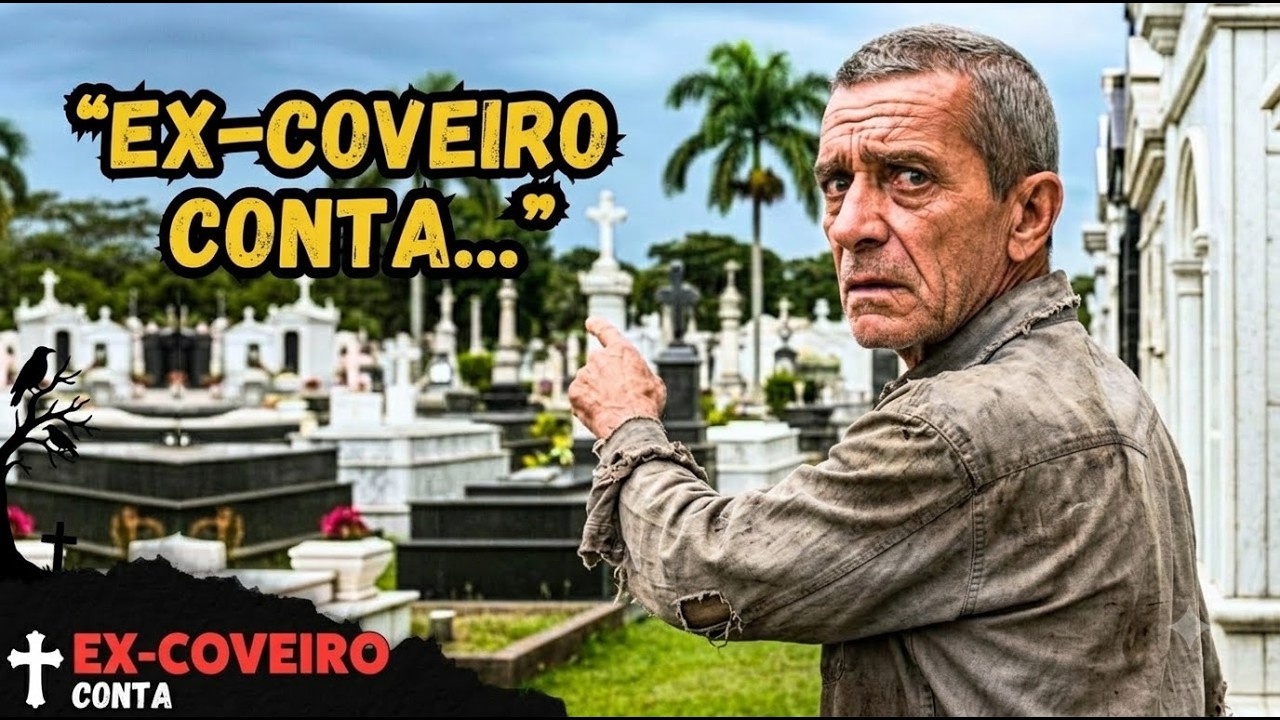
I worked for 17 years as a gravedigger in Porto Velho, Rondônia, and in August 1993 I witnessed something that haunts me to this day. A mother, devastated by the sudden death of her 19-year-old son, returned to the cemetery days after the burial, accompanied by a woman known in the city for performing forbidden spiritual practices while hiding behind a mausoleum.
They formed a circle of black candles [music] around the grave, while murmuring words in a language I had never heard. The ground began to tremble, and the earth in the newly closed grave began to crack and open up. And when something began to emerge from there, it wasn’t the boy the mother had hoped to see again.
It was a distorted form, made of viscous shadows. with empty holes where its eyes should be, emitting sounds of multiple voices, all shouting at once: “My name is Roberto da Silva Costa, I am 64 years old, and this is the story of how I learned that a mother’s love, however profound, cannot bring the dead back without terrible consequences.
” He was born in Porto Velho, Rondônia, in 1959. Son of Benedito da Silva Costa, a railroad worker, timber merchant, and Lourdes, a laundress who served families in the city. I grew up on the outskirts of the port, where the Madeira River ran wide and muddy, carrying stories and secrets that would never be told. We were six siblings.
Me, the fourth, three older brothers and two younger sisters. The house was small, made of wood, with a zinc roof that got too hot in the summer and made a deafening noise when it rained. My father worked in railroad maintenance, repairing tracks, replacing sleepers, doing whatever was necessary to keep the trains running.
He always came back covered in grease and oil, smelling of iron and burnt wood. My mother would wake up before sunrise and go to the river with bundles of clothes. She spent the whole day washing, scrubbing, and wringing. He would return with swollen and cracked hands, but always with some money tucked away in his apron pocket. I didn’t study much.
I only finished the fourth grade. At age 11, I was already helping my father on weekends, carrying tools. Holding the pieces, learning the trade. At 14, I started working for real, as a bricklayer’s assistant, on the construction sites that were popping up all over the city. Porto Velho was growing rapidly back then , in the 70s.
Lots of people coming from elsewhere, lots of work, lots of sweat. At 21, I married Dalva, a girl I met at a saint’s day celebration at a neighbor’s house. She was the daughter of river dwellers, grew up fishing and rowing, had strong hands and an easy smile. We got married in a simple ceremony at the main church.
We had four children, three girls and one boy. Life was hard, but there was always food on the table. In 1976, at the age of 34, I became unemployed. The construction company where I worked went bankrupt. The owner disappeared without paying anyone. I spent three months doing odd jobs, carrying boxes at the market, helping with moves.
Anything that came up. That’s when my brother-in-law told me about the job opening. They needed a gravedigger at the Santa Margarida public cemetery, fixed salary, formal employment contract. It wasn’t the job I dreamed of doing. Nobody dreams of being a gravedigger, but it was honest work. And I had a family to support.
I went to do the interview. The administrator, Valdemar, a serious man of about 60 years old, asked me few questions. Do you have trouble working with death? No, sir. I replied. Are you strong? Yes sir. It can start next Monday. And that’s how it was. I started on August 16, 1976. The Santa Margarida public cemetery is located in the eastern part of the city, in a somewhat remote area, surrounded by dense forest on one side and the Madeira River on the other.
It was inaugurated in 1938, so it was almost 40 years old when I started. It was a large cemetery, divided into sections, section A being the oldest, with marble tombs of traditional families. Intermediate sectors B, C, and D; newer sectors E; simple graves. I was trained by Seu Raimundo, a 65-year-old veteran gravedigger who had worked there for 38 years.
A short man, very thin, with sun-tanned skin and calloused hands. He taught me everything. How to measure the hole, how to dig, respecting depth and width. How to use ropes to lower the coffin, how to compact the earth in layers, how to place the temporary cross. Hard work, but done with technique.
Seu Raimundo was a man of few words, but of great wisdom. [music] He always said: “Cemeteries deserve respect, the dead deserve respect, families deserve respect. Never make jokes, never disrespect.” I took this seriously. For 17 years I worked with dignity. I never missed a day, I never slacked off .
I always treated each funeral with the care it deserved. Besides Raimundo, there were three other gravediggers. Dorival, around 40 years old, Jorge, 32, and Antônio, 26. Good people, hard workers. We got along well. He did his work while chatting, sometimes laughing at something silly, but always respecting the environment. The routine was always the same.
He arrived at 7 in the morning. He would change clothes in the locker room, get his tools, check the day’s burial list, dig the necessary graves, wait for the funeral processions, help lower the coffins, cover the graves, do maintenance, and return home at 5 pm.
Some days there was only one funeral, other days there were five or six, it depended. When we had several, we divided the work. Each one dug their own graves. At the time of the burial, everyone helped to carry and lower the coffins. It was a job that demanded respect, but also physical strength. Digging 2 meters deep into hard ground is not easy.
I often came home at night with a sore back and heavy arms. Dalva didn’t like my work. He said it brought bad luck, that I brought bad energy into the house, but he accepted it because I paid the bills. The neighbors also gave me strange looks when they asked where I worked and I answered.
The conversation grew cold, people moved away, as if death were contagious. I learned not to care. For 17 years I witnessed much sadness, mothers weeping over their children’s coffins, widowed husbands unable to stand, orphaned children who didn’t understand, wakes with no one present, just me and the priest, gigantic funerals that closed off entire city blocks.
Each one carried a story, a life that had ended, people who were left suffering. But in all these years I’ve never seen anything that couldn’t be explained. The cemetery was just a cemetery, a quiet, peaceful place with lots of greenery. There were old mango trees, cashew trees, and some palm trees.
It was even beautiful if you looked at it without thinking about what it meant. I worked for 13 years without seeing anything strange. Thirteen years of normal routine until August 1993, until the burial of Diego Ferreira dos Santos, until the day everything changed. The news arrived on Thursday, August 5, 1993. A 19-year-old boy had died in a workplace accident.
Diego Ferreira dos Santos was working as a helper on a construction site downtown when he fell from a third-story scaffold. He hit his head on the cement floor. He died instantly. I remember when Mr. Valdemar passed the information on to me. “New [music] guy ,” he said, shaking his head. 19 years old. What a waste. The family is devastated.
Burial. It will be Saturday morning. You will be digging the grave in sector E, lot 62. I wrote everything down and started work on Friday morning. Section E was located in an intermediate area of the cemetery, neither too close to the entrance nor too far away. There were graves that were 10, 15 years old.
Medium-sized trees provided shade. It was a quiet area. I marked out the rectangle on the ground with stakes and string. I picked up the hoe and started removing the grass. The ground was damp. It had rained the night before. It made the work easier. I dug all morning. With each shovelful filled, I thought of the boy’s family.
In a city like Porto Velho, everyone knows everyone else. I didn’t know Diego personally, but I had heard of his family. The father worked at the central market. The mother was a seamstress, a simple, honest, hardworking person. How could anyone have imagined that their 19-year-old son would die like that, suddenly, in a senseless accident? I finished digging the grave in the early afternoon.
2 m deep, 80 cm wide, 2.10 m long, precise measurements, compacted soil on the sides, level bottom, job well done. I tested the strings I would use on Saturday, cleaned the tools, and went home. Saturday dawned with an overcast sky, heavy, dark clouds, typical of August in Rondônia.
It looked like it was going to pour down at any moment, but it didn’t. The air was humid, heavy, and difficult to breathe. I arrived at the cemetery at 7 in the morning. I checked the grave. It was perfect. I arranged the ropes, I waited. The procession. He arrived at 9 o’clock. A hearse in front, with more than 20 cars behind. People on foot too.
There must have been about 150 people. Large funeral, young man well-known. A tragedy that shook the city. I saw the coffin being taken out of the car. It was simple. Light varnished wood, metal handles, covered in flowers. The family got out of the cars. I saw the father, a strong man, with gray hair, his face marked by the sun and by work.
He was being supported by two men, one on each side. He was staggering as if his legs couldn’t hold him up. The mother was coming right behind. Mrs. Marília. I remember the name because I heard it many times afterward. She was a short, plump woman with black hair tied in a bun. She was hunched over, leaning on two women.
Her face was the very definition of pain, red and swollen eyes, her mouth contorted in silent sobs. She also had siblings, two younger girls, around 15 and 16 years old, who were crying a lot. and several relatives, friends, work colleagues, everyone dressed in black, everyone with a heavy expression.
The priest arrived soon after, Father Augusto, who served several parishes in the region, a man of about 50 years old, bald, with thick glasses. The coffin was carried to the edge of the grave. Six men, three on each side. I stayed nearby, respectfully, waiting for the right moment to help her down. The priest began the ceremony, read the Gospel, spoke about Diego’s short life, about how unfair it was for a young man to leave like that, about God’s plans that we don’t understand, about acceptance and faith.
People were crying, some silently, others unable to hold back, but the one who cried most heartbreakingly was the mother. Dona Marília sobbed loudly, a sound that came from the depths of her soul. Every now and then he would shout his son’s name: “Diego, my boy, why, my God?” It was heartbreaking.
I’ve seen many mothers cry in my 17 years of work. But that pain was different. It was a pain that seemed too big to contain within her body. When the priest [music] finished, it was time to lower the coffin. Dorival and I grabbed the ropes from one side. Jorge and two boys from the family took it from the other. We started to descend slowly.
The coffin was being lowered into the grave, the creaking of the ropes, the heavy silence, only Dona Marília’s sobs filling the space. That’s when she completely lost control, tried to break free from the women who were securing her, and almost succeeded. He was shouting: “Don’t take my son, don’t take my boy!” The father was also unwell.
He tried to approach the grave, but the men held him back. The coffin hit the bottom, and the priest threw dirt on it. Some people also began to say goodbye. Dona Marília couldn’t get out. She knelt there in front of the grave, holding a framed photo of her son. A high school graduation photo. Diego in a suit, smiling.
She pressed that photo against her chest, as if it were the last thing she had of him. The women tried to lift her, but she didn’t want to. He stayed there for a long time. People gradually left . Half an hour later, only the immediate family remained . An hour later, only the mother and her two daughters remained.
Two hours later, only the mother remained. I needed to cover the grave, but I didn’t have the courage to ask her to leave. I waited respectfully, at a distance. That’s when I heard it. She was murmuring, her words low and punctuated by sobs. I moved a little closer to check if he was asking for something, and I heard him clearly.
She said, “I just wanted to see you one last time, my son. Just one more time. To see your face, to touch your hand. Just one more time.” Those words struck me in a strange way. They weren’t simply words of farewell; it was a plea, a supplication, a desire for the impossible spoken aloud.
I felt a tightness in my chest. Finally, the daughters returned and managed to lift their mother. They carried her away, practically dragging her. She looked back several times, still holding the photo, still crying. When they finally left, I began to cover the grave. I threw the earth in layers, compacting it. With each shovelful full, Dona Marília’s words echoed in my head.
I just wanted to see you one last time. I finished the work, smoothed the earth, placed the temporary wooden cross with the name and dates. Diego Ferreira dos Santos. 1974-1993. 19 years old. A whole life ahead, suddenly interrupted. I left there with a strange feeling. It wasn’t the first time I’d heard a mother express a desire to see her dead son again, but there was something in her words.
From Dona Marília, an intensity, a desperation, an almost determined feeling, as if that desire wasn’t just lament, as if it were a promise. I went home, had dinner, tried to sleep, but her words wouldn’t leave my head. I just wanted to see you one last time. Four days had passed since the funeral. Wednesday, August 11th. It had been a normal workday.
Two funerals in the morning, maintenance in the afternoon. It was almost 5:30 PM. The sky was beginning to darken. I was about to close the cemetery when I noticed something strange. There were two figures walking towards sector E, in the distance. I recognized one of them immediately by their movements, by their hunched posture.
[music] It was Dona Marília, Diego’s mother, but she wasn’t alone. There was another woman with her, taller, thinner, walking upright. They were carrying bags. My first impulse was to go to them and tell them the cemetery was closing, but something held me back. Curiosity, perhaps, or a premonition. I decided to observe first. I hid.
Behind an abandoned mausoleum about 20 meters from lot 62, [music] where Diego was buried. The mausoleum had an iron door, slightly open. I went in. From there I had a direct view of the grave. The two women arrived at the tomb. That’s when I recognized the second one. It was Mrs. Valdete. I knew her by sight. Everyone in Porto Velho knew her.
She was a woman of about 55 years old, tall, very thin, with long, gray hair always loose, dark-skinned, with deep-set eyes, always wearing a long skirt and long-sleeved blouse even in the heat. Mrs. Valdete had a reputation; for some she was a healer, a folk healer, a woman of faith who helped those in need. For others [music] she was a witch.
A macumbeira, a woman who dabbled in forbidden things, they said she practiced catimbó, an ancient tradition that mixed indigenous shamanism with Catholicism and other darker things. She said she spoke with the dead, that she could do work that no one else could, that she charged a lot and never It was failing.
I had never gone to her, never needed to, but I knew people who had. A neighbor of mine swore she had cured his daughter of an illness no doctor could diagnose. Another said she had tied up a marriage that was ending. There were also heavier stories of people who had asked her to harm their enemies, and the enemies had fallen ill. Of revenge spells, of things not spoken aloud.
The two began to take things out of the bags, candles. But they weren’t ordinary white candles , they were black. About 10 or 12 black candles. They began to place them around the grave, forming a circle. Dona Marília was crying softly. Senora Valdete worked silently, concentrated, with precise movements.
After the candles, they took out more things. A dark glass bottle, sealed, with red wax. An object I recognized from afar, it was a wristwatch, probably Diego’s. Then, a white cloth that they spread over the earth in the center of the grave. And finally, a bowl of The sun had already set completely. The light of the sky was weak, grayish. The two lit the candles, one by one.
The flames burned steadily, there was no wind. The air was still, completely still. Not a leaf moved, not a sound of birds. It was as if all of nature had stopped to watch. Senora Valdete opened the bottle, poured the contents into the bowl. It was a dark liquid, almost black. Even from afar, the smell reached me.
A strong, bittersweet smell, mixed with something metallic. Blood. There was blood there. She felt her stomach churn. She placed the bowl in the center of the circle of candles, positioned the clock beside it, took the framed photo that Dona Marília had brought and placed it upright, leaning against the wooden cross.
Diego, looking at them, at the ritual. Dona Marília knelt, her hands joined as in prayer, crying. And then, Senora Valdete began to speak. They weren’t words in Portuguese, it was another language. It seemed Old Tupi mixed with something else. Drawn-out, guttural words, in an almost sing-song rhythm. She repeated sequences, stopped, started again.
Her voice was firm, unwavering, as if she knew exactly what she was saying. Dona Marília repeated some words behind her, without understanding, just repeating, like someone praying in an unknown language, trusting in the faith of the one who teaches. Her eyes were closed, tears streamed down her face, her lips moved.
From time to time she said in Portuguese: “Come back to me, my son, just one more time.” “Let me see you.” I was paralyzed inside the mausoleum. My heart was pounding. Part of me wanted to run away, leave , never look back. But another part was rooted to the spot, unable to look away. It was like watching something forbidden, something that shouldn’t be seen, but couldn’t be ignored. The ritual continued.
10 minutes, 15, 20. Senora Valdete didn’t stop. The words flowed, sometimes louder, sometimes softer, but always at the same rhythm. Dona Marília kept repeating, crying, pleading. The candles burned without flickering. The air grew heavier and heavier. I felt a pressure in my chest, as if breathing required effort.
And then I noticed something that chilled me. The silence. It wasn’t just the absence of sound, it was the presence of emptiness, as if the air had been sucked out. My ears began to ring slightly. The pressure increased. I felt dizzy. I leaned against the mausoleum wall to avoid falling. That’s when the earth began to move in the c
enter of the… A circle of candles, where the bowl had been. The earth began to ripple slightly, rising and falling, as if something beneath were breathing. My eyes widened. It couldn’t be, but it was. The earth was moving. Senora Valdete raised her voice. [music] The words became faster, more urgent. Dona Marília also raised her voice, now shouting: “Diego, come back, my son, come back to your mother.
” The earth rippled more strongly and then began to crack. Small cracks opened, then larger ones, as if something beneath was pushing, trying to get out. My whole body was trembling. I wanted to scream, but my voice wouldn’t come out. I wanted to run, but my legs wouldn’t obey. I just stood there watching, witnessing the impossible happen before my eyes.
And then the earth opened and something began to emerge. In the first second, my brain tried to process what it saw as something normal. It tried to fit it into what I knew, but there was no possible framework. What came out of that tomb did not belong to this world. The form emerged slowly. First, just a silhouette. It looked human.
It had the height of a man, the width of his shoulders, the general body shape, but it was completely wrong. The substance that composed it wasn’t flesh, it wasn’t skin, it was like damp, black, viscous soot, moving, dripping, trying to stay cohesive, but constantly failing, as if the body were falling apart and rebuilding itself at the same time.
It had no defined face. Where the features should have been, there were only holes, two deep holes. In place of the eyes. They weren’t empty cavities, they were more than that. They were wells that sucked. They sucked the light from the candles, they sucked the color from the air around them.
When those holes turned towards me for a second, I felt as if something was being ripped from inside me. An emptiness, an absence, a part of my soul being sucked away. The smell hit immediately afterward. An unbearable smell of sulfur mixed with rotten flesh. A smell so strong that my eyes watered. I covered my nose and mouth with my hand, but it was no use.
The stench penetrated, entered my lungs, clung. It was the smell of death, but not of natural death, of wrong death, of something that died and was forced to return without having the right. The creature writhed, its movements were impossible, they didn’t follow the logic of joints. What should have been an arm bent at angles that bones don’t allow.
What should have been a neck rotated completely. The parts didn’t work together. Each moved independently, obeying its own rhythm. It was like watching several bodies trying to exist in the same space at the same time. And then came the sound. The worst of all was a high-pitched screech superimposed on a deep groan, as if three different throats were screaming simultaneously at impossible frequencies.
It wasn’t a sound that human vocal cords could produce. It was something that scratched the ears, that pierced, that made the brain ache. Dona Marília was frozen, her eyes wide. Her mouth open in a scream that wouldn’t come out, her hands outstretched as if she wanted to touch, but She couldn’t move. Her face was a pure expression of horror, of realizing that it wasn’t her son, it wasn’t Diego, it was something else.
The creature continued to emerge, now completely out of the ground. It stood there , writhing, emitting that horrible sound. The holes where [music] the eyes should have been fixed on Dona Marília. She took a step back, stumbled, fell sitting down, tried to crawl away, but couldn’t take her eyes off that thing.
That’s when the creature began to move towards her. It wasn’t walking, it was gliding, dragging, as if its feet didn’t fully touch the ground, as if it were floating, but in a wrong, uncoordinated way. With each movement, the form dissolved a little more. Pieces of soot dripped and fell to the ground, where they dissolved into dark smoke.
Dona Marília finally screamed a sharp, desperate cry. She tried to get up, but her legs wouldn’t obey. The creature came closer, 2 m, 1.5 m The sound it emitted grew louder, more distorted. It seemed as if several different voices were shouting her name, Marilia, but distorted, drawn out, as if coming from very far away and very close at the same time.
It was then that Dona Valdete acted. She had been motionless until that moment, only observing, but now she moved. She took a small bottle from inside her clothes , a clear glass bottle with a clear liquid. She opened it quickly, advanced towards the opening in the ground and threw the contents in. The effect was instantaneous.
The creature let out that impossible scream, but this time in a torrent. It was pain, it was despair. The form began to disintegrate faster, the pieces falling, dissolving. Dona Valdete shouted words. It was no longer singing, it was command, order, a name she could n’t understand, a name her brain couldn’t process.
It was as if the syllables escaped her memory the instant they were spoken. The creature tried to advance, but couldn’t. It began to be pulled back into the opening, as if an invisible rope were pulling it back. It dragged itself along. She writhed, screamed, tried to resist, but was being sucked in.
First her feet, then her legs, her torso, her arms trying to grab onto something. And finally, [music] her misshapen head with those empty holes, staring at Dona Marília until the very last second. And then it disappeared. The earth suddenly closed, as if it had never been opened. The cracks vanished.
The surface became smooth, as it had been before. The candles all went out at once. Silence returned, but it wasn’t normal silence, it was heavy, suffocating silence, a silence of mourning. Dona Marília was on the ground, trembling. Her eyes, still wide open, fixed on the spot where the creature had disappeared, she began to cry.
It was no longer a cry of pain for the loss of her son. It was a cry of horror, of regret, of having seen something that should never have been seen. Senora Valdete approached her, knelt down, held her shoulders, but said nothing, only held them. I remained in the mausoleum. I couldn’t move. My whole body… I was trembling.
Cold sweat ran down my back. My heart was pounding so hard it hurt. My breathing was short and rapid. I felt nauseous and dizzy. I wanted to vomit, but I couldn’t. I stayed there for I don’t know how long. It could have been 5 minutes, it could have been 20. When I finally managed to regain some control of my legs, I looked at the grave again.
Senora Valdete was helping Dona Marília to get up. The two of them started gathering things—candles, bowl, bottle, everything— back into the bags. Quickly, as if wanting to get out of there as soon as possible. When they started walking towards the exit, I hid completely inside the mausoleum. I waited until I heard the footsteps fading away, until the silence returned.
Only then did I come out. I looked at the grave from afar. It seemed normal: packed earth, wooden cross, nothing betraying what had happened there minutes before. But when I got closer, I saw. The earth was different, darker, almost black, and it had a smell. Weak, but it smelled of sulfur.
I retreated, locked the cemetery gates, and ran. I went home almost running. I went inside. Dalva was in the kitchen, she looked at me, startled. “Are you alright? You ‘re pale?” I couldn’t answer. I just went to my room, lay down, pulled the sheet over my head, and spent the whole night awake, going over everything again: the shape emerging, the empty holes, the impossible sound, the smell, the horror on Dona Marília’s face, every detail etched into my memory with cruel clarity and absolute certainty.
I saw it wasn’t a dream, it wasn’t imagination, it was real. The next morning, Thursday, I went back to work. I arrived early. Before doing anything else, I went to plot 62, Diego’s grave. The daylight seemed completely normal: packed earth, a wooden cross, withered flowers that someone had left days before.
But when I bent down and touched the earth, I felt it was cold, icy. Even with the strong morning sun beating down directly, I looked around. None of the black candles were there, no trace of the ritual. Senora Valdete had taken everything or hidden it, but the smell… It remained light, but there was sulfur, rotten flesh, mixed with damp earth. I got up quickly.
I didn’t want to stay near there. During the following days, I tried to work normally, I dug graves, helped with burials, did maintenance, but I was different, distracted, scared, any noise made me jump, any shadow made me turn away, and I avoided passing near the area and always made excuses to work in another area.
The other gravediggers noticed. “Roberto, you’re acting strange,” Dorival said one afternoon. “Did something happen?” I shook my head. “Nothing, just tired.” He didn’t insist, but he continued to look at me suspiciously. I couldn’t tell them. Who would believe me? They would think I’d gone crazy, that I’d worked in a cemetery for so long that my head had turned.
Two weeks after the ritual, in the second half of August, I heard news. Dona Marília had become seriously ill. She was hospitalized, with a high fever and delirious. The doctors couldn’t figure out what it was. They did tests, but nothing showed up. She was delirious, screaming, calling out… The son’s name. They said she had aged 10 years in two weeks.
A month later, in September, there was more. Her hair had turned completely white, overnight [music] all black turned white. And she no longer left the house, didn’t speak to anyone, stayed locked in her room. Her daughters took care of her, but she was no longer the same. It was as if something had broken inside her, something that would never be fixed.
As for Mrs. Valdete, she disappeared a week after the ritual; no one saw her again . Her house was empty, locked. Neighbors said she had left in the early morning. She only took a suitcase, leaving everything behind. Some said she ran away, that she was afraid that the thing [music] she invoked would come back to her.
Others said she left because she knew she had gone too far, that she had opened a door she shouldn’t have. I never saw her again and never heard from her again. She disappeared completely, as if she had never existed. In the following years, I continued working at the cemetery, But something had changed in me.
I developed fear. Fear of cemeteries, fear of graves, fear of the dark, fear of silence, things I had never felt before. At night I had nightmares. I dreamed of that form emerging, of the empty holes staring at me, of the impossible sound. I would wake up sweating, screaming. Dalva was worried, she took me to the doctor.
I took medicine, it helped a little, but the dreams never completely stopped. I also noticed something strange . In that grave, in plot 62, nothing grew. Around it, the grass grew normally, but there, in that specific area, the earth remained bare, dark even years later. I tried planting grass, it died. I tried planting flowers, they withered in days.
It was as if that piece of ground had been marked, contaminated, as if the earth remembered what had happened and rejected life. Three years after the ritual, in 1996, Dona Marília died. She was only 48 years old. The official cause was cardiac arrest, but everyone knew. She died of Sadness, horror, at having seen what she saw, at having invoked what she invoked.
Her funeral was small, few people, her daughters, some close relatives and neighbors. She was buried in the same cemetery, section C, far from her son. During the ceremony, I watched from afar. I didn’t participate directly. The daughters cried, but it was a different kind of crying. It wasn’t just pain from the loss, it was also relief.
Relief that their mother’s suffering was over, that she had finally found peace, or at least that’s what they hoped. I continued working until 2010, 17 years in total. I retired as soon as I could. I couldn’t take it anymore. It wasn’t the physical work, it was the weight, the fear, the memories. I needed to get out of there.
I never went back, not even to visit, not even to pass by. I even avoid that side of town. Today I am 64 years old. I have been retired for 15 years. I live in a simple house with Dalva. The children grew up, got married, have children of their own. Life went on, but that August night in 1993 never went away. It’s still here. Recorded.
Every detail vivid, as if it happened yesterday. I learned things I wish I hadn’t learned. I learned that there are doors that shouldn’t be opened, that there are calls that shouldn’t be answered, that love, however deep and true , has no power to reverse death. And that when we try, what comes back isn’t what we lost, it’s something else, something wrong, something that shouldn’t exist.
Dona Marília only wanted to see her son one last time, she only wanted to say goodbye, touch his face, tell him she loved him. It was an understandable, human, natural desire. But she went further. With the help of Dona Valdete, she tried to bring him back and succeeded. But what came back? It wasn’t ego, it was distortion, error, an abomination molded from his memory, but without anything of what he was.
A mother’s love is the most powerful force that exists, but it’s not greater than death. Death is the end, it’s passage, it’s a door that closes and doesn’t open again. When we force it open, we break something fundamental. And what comes out of that crack doesn’t… It is life, it is the absence of life. It is emptiness trying to take shape.
It is a mistake that should not be witnessed. I witnessed it, I saw it with my own eyes, and I carry this with me. Sometimes I wonder if I should have interfered, shouted, run there and stopped the ritual. But I know it wouldn’t have mattered , I was paralyzed. And even if I hadn’t been, what could I have done? They had already decided, they were already in the middle of it, and some things, once begun, need to end.
Today, old, I can only advise those who have lost someone, those who suffer from absence, those who desperately want one more moment: don’t try, don’t call, don’t invoke, let the dead rest, let the separation exist, however painful it may be, because what comes when we call does not bring comfort, it brings horror. My name is Roberto da Silva Costa, I am 64 years old.
I was a gravedigger for 17 years in Porto Velho, Rondônia. I saw something in August 1993 that no one should see. And I tell this story not to scare, but to warn. In the world of the dead. You shouldn’t call anyone back. What comes is never what you expect.