Humilharam o Fazendeiro Negro Na Primeira Classe… Então Ele Demitiu Todos Com Uma Ligação!
Humilharam o Fazendeiro Negro Na Primeira Classe… Então Ele Demitiu Todos Com Uma Ligação! 
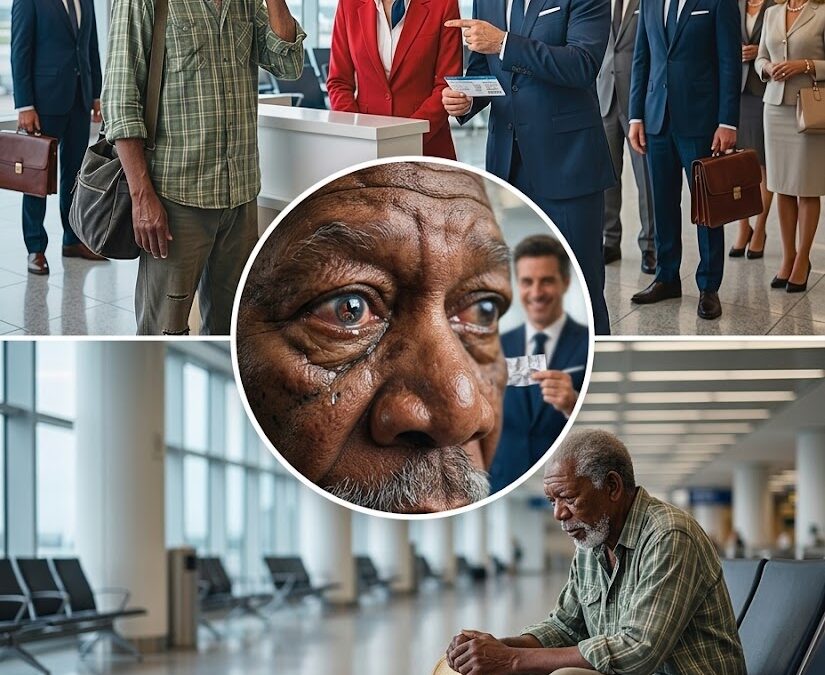
Severino was 72 years old, wore a straw hat and boots, and had a first- class ticket in his shirt pocket. I was in the right line, with the right document, but when I got to the gate, the attendant looked at my card, asked me to wait, and called the manager. Marcelo arrived in a dark suit and glanced at his boarding pass for a moment.
Then he glanced at the straw hat, the plaid shirt, the worn-out boots. He didn’t ask anything, didn’t check anything else, handed the card back and said, “You’ll have to fly economy class.” The first-class passengers heard. Some looked at Severino, others pretended not to have heard. Nobody said a word. Severino stood still, looked at the man, and took his cell phone out of his pocket.
He dialed a number he knew by heart. He spoke three words, then hung up. Marcelo smiled again, convinced that the discussion was over. He had no idea that those three words had just decided his future. If you like seeing justice done, click “like” and stick with me, because this story is just beginning.
Severino Campos was 72 years old and had an appearance that most people would dismiss in 2 seconds. A faded straw hat, a plaid shirt, worn leather boots with soles showing their age, a simple, unbranded, wheel-less carry-on bag slung over the shoulder like any old shopping bag. That was exactly how he traveled the world.
And that was exactly how the world used to treat him before they heard him speak. No one who crossed paths with him in a hallway would imagine what lay beneath those simple clothes. And Severino never felt the need to change that. The trip had been booked months in advance. The reason? He hadn’t told anyone except his eldest daughter, who drove him to the Brasília airport one Tuesday morning without asking any questions.
There was someone in Lisbon, a childhood friend he hadn’t seen in person for almost 20 years, who had insisted he go and had sent the ticket as a gift. Severino put it in his shirt pocket, didn’t make a fuss, and left. He arrived 3 hours early. It was his habit in everything in life, in farming, in negotiations, in conversations that mattered.
He presented the document at check-in without any problem. He grabbed his boarding pass and walked through the terminal with that long, unhurried stride of someone who doesn’t need to rush for anything. The preferred boarding gate was at the end of the corridor. There was a short line, executives in suits, couples with designer bags, a younger man with headphones on and a look that suggested he preferred not to see anything around him.
Severino arrived, positioned himself in line, and waited. The attendant at the gate was called Denise. She had the kind of posture of someone who had learned to smile without her eyes getting hot. Hair tied back, uniform impeccable, the way he moved behind the counter with an efficiency that sometimes bordered on coldness.
When it was Severino’s turn, she looked at him for a fraction of a second longer than necessary, and then looked at the line behind him. That sequence of glances, that back-and-forth look, already conveyed her thoughts before she even opened her mouth. Good morning. Your boarding pass, please. Severino handed it over.
She looked, looked again, and said slowly, in the tone of someone explaining something simple to someone who didn’t understand. Sir, you must be confusing the queue. This gate is for priority boarding. ” I know,” he replied in the same calm tone he used to say anything else. I need an additional document to confirm.
It was not standard procedure. Anyone who had gone through check-in with that boarding pass had already been verified. But Denise asked anyway, with her smile still in place, as if she were doing someone a favor. Severino handed over the document without arguing. She typed something, waited, and typed again.
Then he said he needed to call the supervisor. He asked him to wait a moment by the counter while the other passengers continued to board normally around him. Nobody said anything, nobody asked anything. The executives in suits looked away with the convenient haste of those who prefer not to get involved. Hélio arrived two minutes later.
He was the shift supervisor, a middle-aged man with a crooked name tag and the look of someone who had been taken from something else and wasn’t happy about it. He arrived looking at the screen of the laptop he was carrying, typed something while standing, and then said, without raising his eyes to Severino, “I’ll need to confirm with the operations manager.
” Why? Severino asked. Helios finally looked at him. For a second, it seemed like he was going to say something, but he just said, “Procedure!” And he made the call. Severino stood still. More passengers boarded. The line was getting shorter. He observed everything with a calmness that wasn’t resignation, it was something else.
It was the manner of a man who had spent his entire life dealing with people who underestimated him before he even opened his mouth. And she had learned long ago that reacting at the wrong time is a waste of energy. Marcelo arrived 5 minutes later, the airport’s operations manager. Dark suit, carefully combed hair, the kind of man who confuses authority with arrogance and has never noticed the difference.
He walked to the counter with measured steps, looked at the screen that Hélio pointed to, then looked at Severino, hat, boots, suitcase on his shoulder, and took a deep breath before speaking. Sir, there was an inconsistency in the system. The seat number registered for this document is listed as economy class.
“This ticket was issued by the company’s president,” Severino said, without changing his tone. Marcelo tilted his head slightly. He had the air of someone who had already made up his mind and was simply fulfilling the formality of explaining it. I understand. But the system is the system. To avoid further embarrassment, I can accommodate him very comfortably in economy class.
Are there seats available? He didn’t ask. He decided. Nearby, three first-class passengers heard everything. One of them looked at the other. No one said anything. Severino stared at Marcelo for a moment. There was no anger on his face. There was no visible humiliation, nor that urgency of someone who needs to prove something right away.
There was only that calm, dense, ancient feeling [clearing throat] built up over decades by a man who knew exactly who he was, even when others hadn’t the slightest idea. Then he carefully placed the suitcase on the ground, took his cell phone out of his plaid shirt pocket, and dialed a number he remembered. Marcelo waited with the expression of someone who thinks he’s in control of the situation. The call was answered.
Severino spoke three words. They put me in economy class. On the other side, a short pause. Then a voice simply said, “You can leave it to me.” He hung up, looked at Marcelo, and said in his usual voice, “Okay.” Marcelo smiled with the quiet satisfaction of someone who feels he has achieved something.
Hélio relaxed his shoulders. Denise went back to the counter as if nothing had happened. None of the three had any idea who was on the other end of that call. And none of the three imagined for a second that those three words had just changed their destinies. Severino boarded without haste.
He walked down the aisle of the plane with his suitcase on his shoulder and his hat still on his head, ignoring the stares of those comfortably seated in first class. Those wide armchairs, the glasses already set, the comfortable silence of someone who has never had to explain themselves to anyone. He drove through all of that without slowing down and went all the way to the back, where the seats were narrower.
The space between the rows was barely big enough for a tall man’s legs, and the air already had that stuffy smell of too many people in a small place. He found the seat number. She placed the suitcase in the overhead compartment with the same care as always. He sat down, adjusted his hat in his lap, and stared straight ahead.
There was no anger at that moment. There was a different kind of tiredness. Not the weariness of someone who has been knocked down, but the weariness of someone who has risen so many times from the same ground that the body begins to retain the memory of each fall. The flight attendant’s name was Paulo. I had received the warning by radio even before boarding.
The passenger was reassigned at the request of ground management and had signed the internal registration form without asking any questions. It was easier that way. In his 20 years in aviation, Paulo had learned that in some situations it was better not to touch the aircraft. He recorded it as protocol, put away his pen, and went to take care of the rest of the operation.
It was flight attendant Patricia who saw everything. I was at the gate when Denise asked for the additional document. I was in the hallway when Marcelo appeared in his dark suit, with the voice of someone who decides the fate of others without hesitation. She saw Severino standing there with a calmness that didn’t seem like weakness, but rather a choice, and she was troubled by it, not quite knowing what to do, because it wasn’t her area, it wasn’t her job, and nobody had asked for her opinion.
But when he got to the row where he was sitting, he did a simple thing. She looked at him genuinely, not with pity, not with curiosity, but attentively, and asked if he wanted anything before takeoff. Severino looked at her for a second. “Water,” he said. She brought it. I also brought a blanket that he didn’t ask for because the cabin was cold, and he left it without comment.
I didn’t know who he was, I didn’t know anything. There was just something about that man, the way he occupied that small seat, without shrinking, without agitation, without the posture of someone being humiliated, that made her pay attention in a different way. The plane took off. During the first few hours, Severino stood looking out the window.
Brasília faded into the distance below, the city lights becoming mere dots. Then nothing. He had traveled extensively in his life, in a packed truck when he was young, by car when he started having the money for it, by plane when the business grew to the point where it required speed, but he always had the same relationship with travel.
It was the time between one thing and another, and it should be enjoyed in silence. He slept for almost 4 hours straight. When he woke up, the plane was over the Atlantic and the cabin was dark. Patricia walked down the aisle with a small flashlight, checking on the passengers. He saw that he had woken up and approached him quietly.
More water? ” Maybe,” he said. She brought it, and this time she stayed a second longer than she needed to. There was a question on her face that she didn’t quite know how to phrase. He realized. “Go ahead and speak,” he said. “Are you alright, sir?” Severino paused for a moment to ponder the answer. It wasn’t a simple question, even though it seemed like one. “Am I?”, he said.
“Thank you for asking.” She nodded and left . That was enough. On the other side of the Atlantic, at that very moment, something was happening that Severino didn’t know about, but which had already been set in motion by those three words he had spoken at the gate. When the call dropped on the other end of the line, the man who had answered stood there for a few seconds with the phone in his hand.
Then he dialed another number. He spoke in a voice the person on the other end had never heard from him before. It wasn’t anger, it was something colder than anger. I need the complete flight report from Brasília. Passengers, boarding records, internal communications, everything. Now, the operations director who answered didn’t ask why.
I had known that voice for 15 years and knew that when it sounded like that , the only correct response was to execute. In less than 40 minutes, the report was being compiled. Denise’s records, Hélio’s call, Marcelo’s decision, Paulo’s signature on the relocation document. Everything was there, every step, every name, every time.
Nobody at that airport had imagined that a three- word phone call from a man in a straw hat would generate a dossier with four names. The plane continued cutting across the Atlantic in the dark. Severino put his hat back in his lap, rested his head against the narrow backrest, and closed his eyes again.
Outside, thick clouds covered the ocean, and there was nothing to see through the window. But he wasn’t thinking about what was outside. I was thinking about a face I hadn’t seen in almost 20 years, a handshake that turned into a hug, in a school with a dirt floor, where two boys sat in the same row and nobody would have bet anything on them.
She fell asleep again, and on the other side of the ocean someone was waiting, with 20 years of longing and a report in hand that would change everything. The plane landed in Lisbon on a clear morning. The commander’s voice announced the arrival with her usual calm professionalism , the temperature outside, and the local time.
Passengers began to move around even before the plane had come to a complete stop, seatbelts unfastened, compartments unlocked, that rush of someone who needs to be the first to get out, without really knowing why. Severino waited, remaining seated while the front row emptied, then the back row, then the middle rows.
Patricia was walking down the hallway, collecting cups and packages, and when she reached his level, her eyes met his for a second. He gave a simple nod of his head, the kind of thanks that doesn’t need words. She felt it and continued. He grabbed his suitcase from the overhead compartment, slung it over his shoulder, adjusted his hat, and was one of the last to disembark.
The terminal corridor was wide and well-lit, the kind of place that looks the same in any airport in the world. The same light-colored flooring, the same road signs, the same flow of people walking quickly with distant looks. Severino walked without haste, passed through passport control without any problem, picked up his checked luggage from the conveyor belt, and headed towards the exit.
That’s when he saw it. On the other side of the glass, among people holding signs with names and families embracing, there was a man who stood out without trying. Gray hair, jeans, shirt unbuttoned at the top button, shoulders slightly hunched forward as if he’d spent his life staring at screens and spreadsheets. But what was most striking was his smile, broad, unpretentious, with the kind of joy that can’t be manufactured or rehearsed.
Kaitumori was 68 years old, and 20 of those years were spent filled with longing. Severino went out through the automatic door and the two met in the middle of the crowd without having arranged anything. No formal handshake, no words first, just a long hug in the middle of the terminal, without caring who was passing by .
When they parted ways, Kaito looked him up and down, with that way of taking stock of his emotions, checking if time had done what time always does. “How was the flight?”, he asked. “Did I sleep well?”, Severino said. Kaito stared at him for another second. There was something about that answer, too short, too neutral, that he recognized. I’ve known him for 40 years.
Seriously? He said softly. Severino did n’t answer, he just picked up his suitcase and gestured with his head towards the exit. Kaitu didn’t insist, but as the two walked down the hallway toward the cars, he discreetly took his cell phone out of his pocket and reread the message he had received from the operations director two hours earlier.
The report was complete. Four names, each decision documented, each time recorded, each signature in place. He put his cell phone away without saying anything. Outside, Lisbon welcomed the morning with that particular light the city possesses, white and direct, without the humidity of Brazil, striking the tiled facades with a clarity that seemed to wash everything clean.
Caio had a car waiting, but suggested they walk a little first. Severino agreed without hesitation. They walked for about 15 minutes without talking much. Kaito pointed out a few things. A bakery that had existed before he arrived in Lisbon. A square where he used to sit in his early years when he did n’t know anyone in the city and needed a place to think.
Severino listened, watched, and commented little. That’s just how they’ve always been . At the dirt-floor school where they had grown up together in the Brazilian countryside, neither of them was the type to talk much. Caito was the son of a Japanese man who had come to work in agriculture and stayed.
Severino was the son of a man who had inherited a piece of land from a grandfather who never signed any documents. Both had grown up knowing what it was like to be underestimated before they even opened their mouths, for different reasons, but with the same result. This had created a language of their own among them, made more of silence than of conversation.
When they reached the car, Kaito stopped before opening the door. He looked at Severino with a different expression. It was no longer the smile of reunion, it was something else. “ You know I saw the report,” he said. It wasn’t a question. Severino was silent for a moment. “I imagined,” he said, “Four people made a decision about you yesterday.
” Kaito continued in a calm voice that had something definitive about it. “Three at the gate and one inside the plane, all registered.” Severino didn’t answer immediately. He looked at the street, at the city’s movement , the beginning of the day, at a pigeon perched on a windowsill across the street. “What are you going to do?” he asked.
Kaito opened the car door. “That I’ve already decided,” he said. “But first, someone needs to be part of this conversation.” They got into the car. The driver sped off toward the airport’s private aviation terminal, a 15- minute drive away. Kaito looked out the window with his phone in his hand, and Severino watched the city passing by outside.
Neither of them spoke during the drive, but when the car stopped at the terminal entrance, Severino saw a man in a suit waiting at the door with a tablet in his hand and an expression of someone waiting for a… order. He understood that what had begun at a boarding gate in Brasília was far from over. Caito got out of the car, looked at the man in the suit and simply said: “Set up the room.
” “I want all four of them on screen in 40 minutes.” The VIP lounge at Mor Airways, in the Lisbon terminal, wasn’t large. A long table, eight chairs, a screen on the back wall, and a videoconferencing system that the man in the suit was setting up when Cito and Severino entered. There was a pitcher of water in the center of the table, two glasses, and nothing else.
The kind of room that exists for decisions, not for comfort. Kaito sat at the head of the table. Severino sat beside him, placed his suitcase on the floor and his hat on top of it. The man in the suit finished the setup, confirmed the connection with a nod, and left, closing the door carefully.
For a moment, the two were silent. Outside the room, through the glass separating the space from the terminal corridor, some employees passed by, slowing their pace unintentionally. There was something about the composition of that scene. Two men sitting in a closed room with a blank screen and closed expressions that conveyed weight without needing a caption.
“Do you want to be here when they come in?” Kaito asked. Severino thought for a second. “I do,” he said. Kaito nodded, picked up the phone, sent a short message, and in less than two minutes the screen on the wall lit up. The image took a few seconds to stabilize. Then four windows appeared side by side, four connected faces from Brasília, each in a different environment.
Denise was in a small room, which seemed to be an internal meeting room at the airport, her uniform still in place, her hair tied up in the same way as always. Hélio was standing, leaning against a wall with his badge crooked, just like the day before. The flight manager, Paulo, appeared sitting in an office chair, looking at the camera with the expression of someone who doesn’t quite know what to expect.
And Marcelo? Marcelo joined the call, adjusting his collar, running his hand through his hair, and looking at the screen with the posture of someone who has been summoned to a routine meeting and is ready to conduct it. Kaito let the image stabilize, letting the silence last a few seconds longer than was comfortable.
Then he said: “Good morning.” “Before we begin, I want to introduce a friend.” He turned the camera slightly, and the four faces on the screen saw Severino, his straw hat perched on his suitcase, his plaid shirt, his usual calm expression, sitting next to the president of Mori Airways, as if he were sitting on his porch. Marcelo’s face changed first.
It was quick, less than a second, but it was enough. The routine meeting posture disappeared. In its place was something he tried to hide and couldn’t completely: recognition. And along with it, the understanding of everything that recognition meant. Denise looked away at the table. Hélio remained motionless.
Paulo looked down. Outside the glass- walled room. Terminal employees had slowed their pace without realizing it. There was something in that composition. Two men sitting calmly before four faces that clearly weren’t well, something that conveyed weight without needing a caption. The screen flickered once. The connection was stable, and no one in the room said a word.
Kaitu looked at Severino. Severino looked at the screen, and when he opened his mouth, the silence became even more profound. Heavy, because everyone on the other side already understood that what was coming wasn’t a conversation, it was an accounting. Severino started with Denise, in his usual voice, without raising his tone, without haste, asking which company rule authorized requesting additional documents from a passenger who had already gone through check-in with a valid boarding pass in hand. Denise opened her
mouth, closed it, looked to the side of the screen as if there were a way out in that direction. There wasn’t. ” I’m waiting,” Severino said. She didn’t answer. He turned to Hélio, asking why the shift supervisor had contacted the operations manager instead of resolving the situation according to standard protocol.
Hélio remained motionless with that expression of someone calculating if there is any way out and gradually realizing that there isn’t. ” Procedure,” he said, using the same word he had used at the gate. “Which procedure specifically?” Severino asked. Hélio remained silent. Marcelo had spent the first few minutes with his posture still in place.
Shoulders straight, eyes fixed on the camera, the kind of composure he must have practiced over years of meetings. Difficult. But as Severino dismantled each of the others’ answers, with that calm, anger-free precision, composure began to slip, not all at once, but in parts, like a building that begins to crack before collapsing.
When it was his turn, Severino asked what system inconsistency he had found, since the audit report generated in the early morning showed no changes to the seat linked to the document. Marcelo took a deep breath. There was an indication of a registration conflict that… The report shows no conflict. Severino said without changing his tone.
“It shows the original seat unchanged since its issuance. Can you tell me specifically what conflict you saw?” Marcelo looked at the table, didn’t answer. Severino looked at him for a moment, not with anger, not with satisfaction, with the calm of someone who had spent decades being underestimated by people exactly like that and had learned that the most powerful answer is simply to keep asking until silence says it all.
He turned to Paulo, asking on what verified information he had signed the relocation document. Paulo said he had received the warning by radio and followed the instructions. From ground supervision. Severino asked if it was standard procedure to sign a relocation without direct contact with the passenger. Paulo looked at the table.
The room in Lisbon was in absolute silence. Outside the glass, more employees had stopped. There were now six or seven people observing through the glass, unable to hear anything. Only the expressions, only the composition of that man in the straw hat, asking questions that four people couldn’t answer. When Severino finished, he leaned back slightly in his chair.
Kaito stared at the screen for a long moment. Then he looked at the operations director who was standing near the door with the tablet in his hand, and said in a voice that didn’t need to be raised to weigh heavily. The decision has already been made, the four of you today have a formal record of conduct. The director made a note. Kaito hung up the call.
The screen went black. On the other side, Marcelo stared at his own reflection on the blank screen for a few seconds. He was the last to get up from the room in Brasília and when he left he didn’t straighten his collar. In Lisbon, Kaito stood still, staring at the black screen for a “That’s it,” he said. Then he turned to Severino. “It’s over,” he said.
Severino picked up his hat from the floor and put it on his head. “Let’s see this city,” he said. The two left the room side by side, without haste. Outside, the employees who had been watching looked away. But one of them, a younger woman who was near the door, saw Severino’s face as he passed. There was no triumph in it, no visible relief, only that old calm that hadn’t changed at all since he had entered that room.
She thought about it for a long time after the two left. Outside, Lisbon continued its day with that white light hitting everything. And none of the four people who had just lost their jobs imagined at that moment that the decision had been made by a man who had slept four hours in an economy seat without complaining once.
Lisbon gradually appeared as the two walked without a planned destination. No, not the postcard Lisbon, but the real Lisbon. A lady watering flowerpots in a second- floor window. Two men arguing about the price of fish in an open doorway. The sound of a tram. Turning a narrow corner, Kaito knew every detail because he had learned the city on foot in the early years when he didn’t have a car and had to get from one place to another with a map in his head.
They stopped at a small bakery with no sign on the facade. Kaito ordered two coffees and whatever else they had. They sat outside. The food arrived without description. Bread, cured cheese, still-warm codfish cakes. Severino ate slowly, looking at the street. It was Caito who broke the silence. “Do you remember Professor Hilda?” Severino gave a small smile.
“I remember. She said I would never learn my multiplication tables. She said my father’s accent would hinder me my whole life,” Kaito said. The two were silent for a moment. “What would she say now?” Severino said. It wasn’t a question. Kaito gave a short, genuine laugh. Then he became serious again, looking at the coffee in his hand.
“You know I followed everything,” he said. “Every year, every piece of news that came out of the municipality, when you bought the second plot, I knew. When you drilled the well.” Artesian, I knew. When your father died and they said you were going to sell everything, I almost called. Almost, Severino said, I knew you were n’t going to sell. I knew you.
Do you remember what the bank manager said when I went to ask for financing? Caito nodded. He said that bad land doesn’t turn into a good business for anyone and looked at you when he said: “I was outside.” Caio said: “I saw your face when you left.” You didn’t say anything. He got into the truck and drove away.
What was I going to say? Nothing. Caio answered. But I thought, this man will come back a different person someday. Severino finished his coffee. “I’m back,” he said simply. Caito paid the bill. The two walked away. Lisbon followed. The Tagus River appearing between two buildings, the smell of grilled fish, a small market in a square.
Severino was walking around looking at everything, with no hurry to get anywhere . On a balcony overlooking the river in the late afternoon, Cito asked: “Were you angry at the gate?” Severino took a long time. “Not angry,” he said. “Tired is different. 418 families.” Kaito said softly, as if he was still processing it. Four continents.
And they looked at her clothes. Severino did not respond. The river continued down below. His father would have remained silent. I quote, he said. “He was quiet like that,” Severino said, “but he cried in secret.” I thought I didn’t know. You knew. I always knew. The two remained silent for a long time. Lisbon was gradually turning on its lights, one window at a time.
Three days later, on the other side of the ocean, Patricia received an envelope in the airport locker room. The supervisor entered with that look of someone handing over something they don’t understand where it came from. “It arrived through the presidency’s internal system,” she said directly to her file. The letter was two pages long.
The first, a formal compliment. The second was the approval of the transfer to the long-distance international route that she had requested two years earlier, denied twice and forgotten on the third because she had stopped believing she was going to leave. She read it twice, looked at the signature. It wasn’t HR, it was Caitori, and below the signature, a short line that wasn’t part of any standard template, because doing the right thing shouldn’t be the exception.
Patricia stood there with the letter in her hand, trying to remember what she had done differently on that flight. The water, the blanket, the question in the middle of the Atlantic—it wasn’t heroism, it was her job, done the way it should have been done from the start. And it was the first time in 8 years that someone had put that in writing.
She carefully folded the letter, put it in her pocket, and went to work. Severino stayed in Lisbon for 10 days . It wasn’t 10 days of a full schedule, nor of appointments scheduled at specific times. Those were the kind of 10 days most people spend their entire lives putting off.
Those days when the day has no obligation to lead anywhere, when breakfast can last until noon and nobody needs to explain why. Keito had canceled meetings, handed over day- to-day management to the operations director, and informed his secretary that he would only attend to truly urgent matters. His closest employees knew that when he did this, there was a reason that didn’t need explaining.
The two wandered around Lisbon without a plan. They returned to the bakery without the sign two more times. They went to Cintra one afternoon and stood on the wall of a palace, looking at the sea below, without taking any photos. They ate fish at a restaurant that used paper tablecloths, where the waiter asked for their name before taking their order.
One night, Caito opened a bottle of wine he had saved for an occasion that never came, and they talked about the dirt-floor school , about Severino’s father and Caito’s father, two men who never met but who would have understood each other. about what it means to build something from scratch when the starting point is already more [clearing throat] difficult than the finish line for many people.
About tiredness that is not weakness. It’s just the accumulated weight of years carrying something that shouldn’t be so heavy. At no point did they talk about what had happened at Brasília airport. Not because it was a taboo subject, but because it had already been resolved. And the two had learned long ago that revisiting what has already been done is a waste of time that could be spent on something else.
On the morning of the 10th day, Caito took Severino to the airport. They drove slowly, taking the longer route that ran along the banks of the Tagus River. Severino gazed at the river through the window with the same attentiveness he reserved for things he knew he wouldn’t see again for a long time .
Lisbon passed by outside, the tiled facades, the stone sidewalks, the yellow trams turning corners that seemed too small for them. At the terminal, the two stopped in front of the international departure gate . Caitu looked at his friend, at his hat, his plaid shirt, his worn boots, the simple bag on his shoulder, exactly as he had arrived.
Exactly as it always was. “You’ll be right back, Kaito,” he said. It wasn’t a question. When are you going to send someone to overtake you? Severino replied. Gaito gave that short, genuine laugh he always had. The two embraced again, slowly, without haste, just as they had met 10 days earlier in the middle of the terminal, with 20 years of accumulated longing.
When they parted ways, there was nothing more to say that hadn’t already been said. Severino picked up his suitcase, adjusted his hat on his head, and left. At the boarding gate, the attendant asked for the document with a smile that warmed her eyes. He checked, returned it, and said the seat was the second one, window seat, first class, immediate boarding. Severino thanked them and went inside.
The plane was different, the route was different, and the airline was different for the connecting leg. The crew knew nothing. The flight attendant who greeted him at the door had the kind of genuine friendliness that comes from someone who enjoys what they do and doesn’t need to pretend. He asked his name, showed him the seat, and asked if he wanted anything before takeoff. “Water?”, he said.
She brought it, smiled, and went to attend to the next passenger. Severino placed his suitcase in the overhead compartment, put his hat on his lap, and gazed out the window as the plane began to taxi. Outside, Lisbon was bathed in that fresh, white, direct morning light, its glare falling sideways on the wings of the plane, a clarity that made everything vivid.
He thought of Patricia, he didn’t know if she had already received the letter, he didn’t know if she would understand where it had come from or why. But there was one thing he knew for sure: that woman in the middle of the Atlantic, in a dark cabin, had done the simplest thing in the world. I had stopped, I had looked, I had asked.
And that, which should have been the bare minimum, had been enough to change something in her life. The plane accelerated down the runway. Severino rested his head against the wide, comfortable backrest, enjoying that first-class silence that separates the seat from the rest of the world. But he knew the difference between the silence of this seat and the one in the other one back there , and he knew that it wasn’t the space that had changed in him during those 10 days, it was something else.
It was that rare feeling, built up over decades by a man who started out without documents, without a fence, and without water, that the world sometimes gets it right—not always, not quickly, not without cost, but sometimes, at the end of a story that began with a man in a straw hat standing in a line that someone thought he didn’t deserve to be in, the world gets it right. The plane took off.
Down below, Lisbon diminished in size: the hills, the Tagus River, the white facades, the cobblestone streets, until it became a collection of dots, then a blotch, then nothing. Severino closed his eyes and fell asleep with the same calm as always, as if the seat had never mattered as much as the person sitting in it.
Some people spend their lives judging those in front of them by their clothes, age, or appearance. But the truth is that respect should never depend on someone’s bank account, job title, or where they are sitting. Severino’s story reminds us that a person’s greatest strength is not always in what they show, but in the character they possess and how they choose to act in the face of injustice.
And you, what would you do if you witnessed a scene like that? He would have remained silent or defended the person being humiliated. Write your opinion in the comments, because I really want to know what you think. If this story touched you in any way, please leave a like so that more people can watch it too. And if you ‘re not already subscribed, subscribe to the channel so you don’t miss the next exciting stories.
Until the next video.