O Filho Ficou Rico e Voltou Para Buscar Seus Pais… Mas Encontrou a Mãe Pedindo Arroz ao Vizinh
O Filho Ficou Rico e Voltou Para Buscar Seus Pais… Mas Encontrou a Mãe Pedindo Arroz ao Vizinh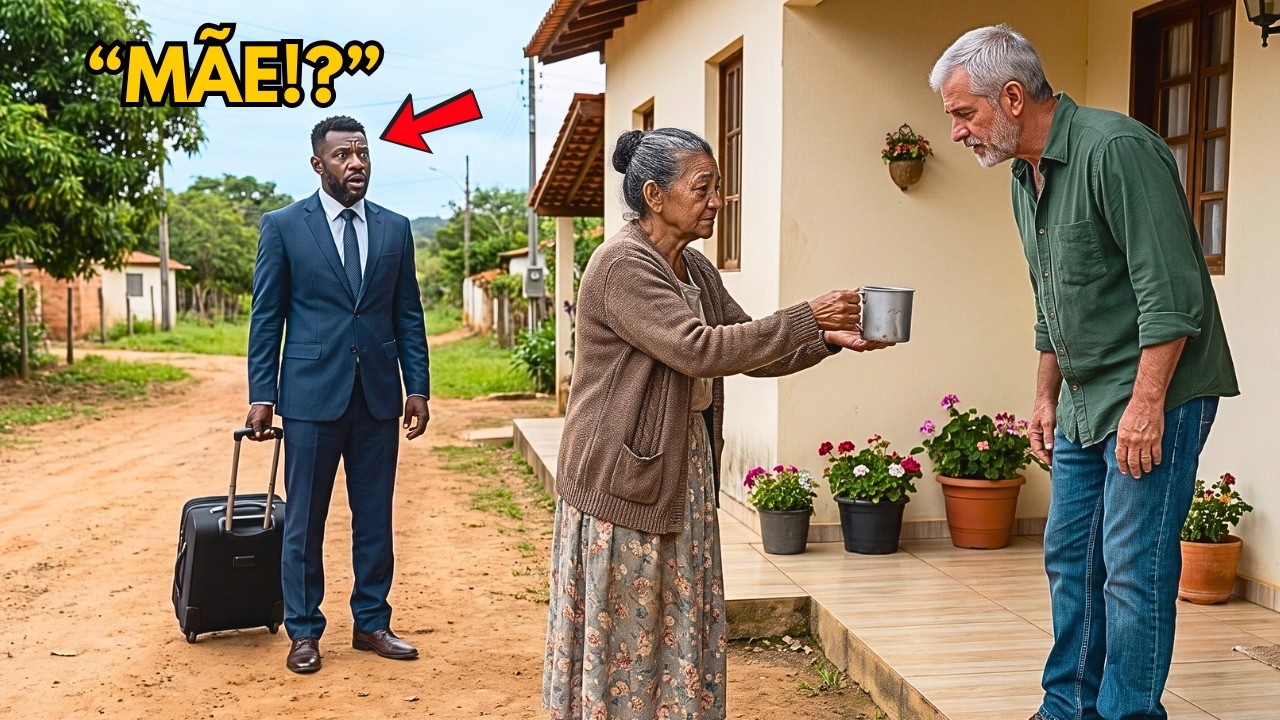
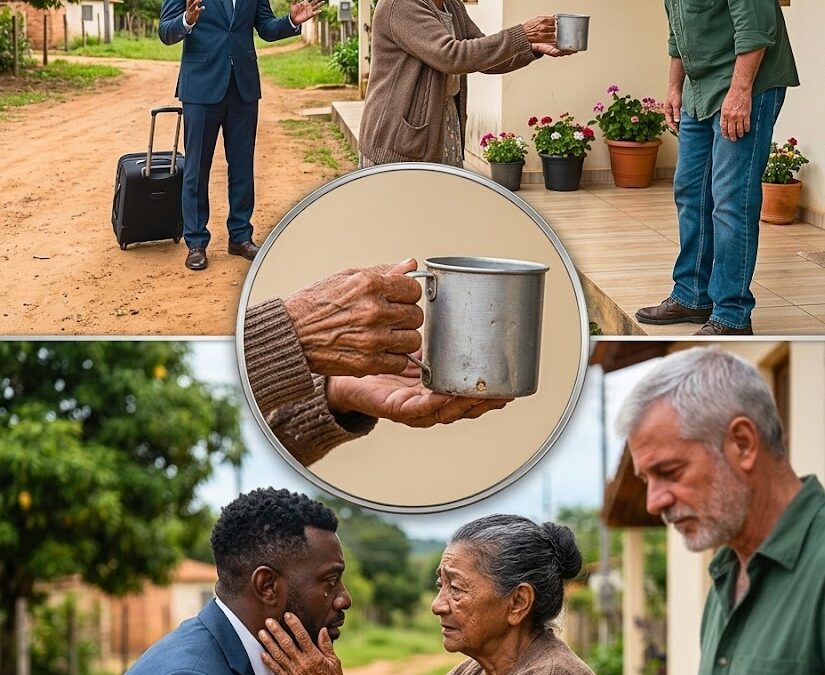
After 10 years away, Vicente had become a partner in a construction company and gotten rich, but only now was he returning to get his parents for good. Before knocking on the front door, he stopped at the corner when he saw Dona Ivone, his mother, at the neighbor’s door, head down, holding an empty tin mug and asking to borrow some rice . His chest tightened.
Vicente had enough money to buy a new house that very day, but there was the woman he had spent 10 years working for, shamefully begging for food at the neighbors’ doors. He had returned home wealthy to rescue his parents from that life, but on that street corner he understood that first he needed to find out why his own mother was begging for food while he was sending money every single month.
If you also want to see the truth come out, leave a like now, because whoever emptied that house still thought no one would find out. Vicente got off the bus with his battered suitcase swaying on his back and his aching feet inside his 10-year-old flip-flops. She had plenty of money to arrive in a rented car with a driver and a new suitcase, but she chose to return simply, without warning, because she wanted to see her parents’ real life before someone had time to tidy up the house or hide whatever it was.
After 10 years of working away from home, he had finally saved enough to buy a better house, bring Nísio and Ivone closer to him, and allow them both to rest for the first time in decades. That was why he had returned, not to visit, but to get his parents for good. The dust from the dirt road clung to his pants the instant he spotted the silhouette of a thin woman across the street emerging from a house that wasn’t hers.
He didn’t need to get closer to recognize the worn dress with patches on the shoulders. The same name his mother used in the photos he kept folded in his wallet belonged to Dona Ivone. And she was clutching a bag that was too small to her chest, walking quickly as if ashamed to be seen. Vicente stopped where he was; he didn’t run towards her.
Something inside him, perhaps the instinct of someone who has spent 10 years analyzing situations before acting, told him that this was not the time to reveal himself. He needed to understand what he was seeing first. He followed his mother from a distance, keeping his distance until he saw her enter the house, his parents’ house, the same house to which he sent money every month without fail in 10 years.
But looking at the roof patched with plastic tarps and the door with the loose hinge, none of it seemed to have received any maintenance whatsoever. Nothing seemed to have received anything. He waited until it got dark to knock on the door. When Anísi opened the door and saw his son standing there with his suitcase on his back, the old man’s face went through three emotions in less than 2 seconds.
Shock, disbelief, and then a dry sob that he tried to stifle with his trembling hand over his mouth. Ivone appeared behind him and couldn’t say anything. He hugged his son tightly, a force Vicente didn’t remember ever feeling before, as if he wanted to confirm through the embrace that he was real. They sat down beside the unlit stove.
There wasn’t enough firewood to light the fire and heat water for a decent cup of coffee. So they drank what they had, lukewarm, in silence, while Vicente waited for someone to explain what he had just seen in the street. Anísio told the story slowly, without drama. The way men his age talk about painful things, as if it were just a minor detail of their routine, he said that things had been tight lately, that his neighbor, Seu Deraldo, had been helping out with a little rice when they ran out, which wasn’t always the case, only when the
month was more bone than meat. But I send money every month, Dad, every single month, without fail. Vicente spoke, and his own voice came out lower than he expected, as if he were afraid of the answer. Anísio lowered his eyes to his own hands. It was Ivone who responded, trying to soften the blow. It was always him, son.
We did n’t have an account. The money would arrive by his hand when it arrived. The name became a common topic of conversation, like a stone thrown into water. Osvaldo. Vicente vaguely remembered him , the owner of the village’s only general store , the man who, without anyone quite noticing, became the only door through which everything the family received from outside passed.
“And Osvaldo always said that you two were doing well?”, Vicente asked. “He always said we were taking good care of our lives, without complaining about anything,” Anísio replied, still without raising his gaze. “He’s a good guy, Vicente, he supports the whole village on his shoulders, lends credit to those who need it, helps when things get tough.
” Vicente said nothing, but something began to stir inside. Not anger yet. It was too early for anger. It was more like that moment when a spreadsheet doesn’t add up and an engineer knows, even before finding the error, that it exists somewhere. The next morning, he decided not to reveal himself in the village. No, he still wore the same worn-out clothes from the trip, put on the same sandals, and went for a walk down the main street, like any stranger, just observing.
He needed to understand the magnitude of the problem before knocking on the right door. It was while walking that he passed in front of the warehouse for the first time. A building with a new facade, a recently replaced roof, a relatively new truck parked next to it . It contrasted sharply with the simple houses around it, including his own parents’ house.
At the door, a robust man, with a thick mustache and a voice that carried everywhere without needing to… He worked hard, laughing loudly with one customer while another waited, head bowed, being ignored. It was Osvaldo. Vicente stood across the street for a while, just observing the movement. He saw families enter with small shopping lists and leave with even smaller bags.
He saw a worn-covered notebook open on the counter, where Osvaldo jotted down and crossed out numbers with a strange, almost rehearsed speed. He mainly noticed how people lowered their voices when speaking to him. It wasn’t respect, it was caution. Before returning home, Vicente stopped at Seudaldo’s grocery store—the neighbor who had helped his mother the previous night.
He bought a little more than he needed on purpose and struck up a conversation slowly, as if just wanting to fill the afternoon’s silence. He asked, without seeming to ask, if Osvaldo’s store was the only place in the village that received shipments from outside. Heraldo looked around before answering, as if the question weighed more than it seemed.
” It’s the only one, yes, young man. Whoever has relatives working outside sends everything through him.” No. “There’s another way in the village. And it always arrives correctly?” Vicente asked, trying to keep his tone light. Deraldo took a second longer than usual to answer. “It arrives what he says it arrived.
” The phrase hung between them. Vicente thanked him, paid, and left, feeling a tightness in his stomach that had nothing to do with hunger. That night, lying on the narrow bed in the room where he had grown up, looking at the patched canvas ceiling, Vicente understood that he hadn’t returned home just to fetch his parents and take them to a better life, as he had planned throughout the trip.
He had returned just in time to discover that, somehow, at some point in the last few years, the money he had been sending with so much sacrifice had stopped arriving, and that the only person who knew exactly where that money had gone was, at that very moment, counting the day’s coins behind the counter of his own store, without imagining that the stranger who had passed by observing the facade earlier was the son he claimed to protect.
The next day, Vicente woke up determined to maintain the same strategy: observe before acting. He put his worn-out clothes back on, slipped on his faded sandals, and left early, telling his parents he was going for a walk to stretch his legs after the trip. Ivone insisted he take a bag and buy what was needed for lunch, since she herself couldn’t go to the market that morning.
He agreed without hesitation. It was the perfect excuse to wander around the village again without raising suspicion. The market was a few meters from the store, in the same dirt square where later a whole crowd would gather for a very different reason. Vicente walked between the stalls, greeting with a polite wave anyone who met his gaze without lingering in conversation.
It was there, choosing a handful of beans at a stall, that he heard Osvaldo’s voice pierce the open space, as if he didn’t care about being heard by everyone. “Look, the millionaire from abroad is arriving, folks,” Osvaldo said, laughing and pointing to Vicente’s worn-out sandal. “He must have come back poor and ashamed to tell anyone.
” A low laugh escaped some nearby customers. Vicente felt his face flush, not from shame, but from a kind of controlled anger that he had learned over the years not to let overflow at the wrong time. He took a deep breath, finished paying for the beans, and kept walking without answering. It wasn’t time yet.
There was still no proof. He remained just an ordinary outsider in the eyes of the village. And a man without evidence who gets angry in a public square only gives ammunition to those who are already experienced in manipulating an audience. It was then that the sky, which had been heavy with rain since early morning, decided to collapse.
The rain started suddenly and heavily, the kind that fills ditches in minutes and forces everyone to run for cover under any available roof. Vicente took shelter with a group of residents under the roof of Deraldo’s grocery store, watching the water form small rivers in the dirt of the square. That’s when he heard the scream.
It came from across the street from the community shed, a simple shack with old tiles, where the village stored the sacks of rice and beans harvested that month; the stock supplied practically half the families in the region until the next harvest. A man was running towards the shed, shouting that the roof was collapsing. Vicente didn’t think twice.
He crossed the street in the heavy rain and entered the shed along with three or four other men who had also run to help. The scene inside was one of controlled panic. An entire section of the old tiled roof was sinking under the weight of the accumulated water, threatening to collapse right onto the tallest pile of rice sacks.
The men were shouting at each other, without coordination, trying to decide whether to move the bags or try to shore up the roof first , wasting precious time arguing instead of acting. Vicente assessed the situation in seconds. Ten years working for a construction company that built buildings in three different countries had taught him to spot structural risk almost instinctively.
He shouted over the noise of the rain, organizing the men into two groups: one group removing sacks closest to the critical point, the other holding wooden beams that were leaning against a corner of the shed to shore up the section that threatened to collapse. He himself went under the most dangerous roof, calculating the exact angle to position the shoring, while water poured down his neck and back.
It took just over 10 minutes, when the roof finally stopped collapsing, held in place by the makeshift beams, and the last sack of rice was safely placed in a dry corner of the shed. The men looked at each other, breathless, not quite believing what had just happened. They hadn’t lost a single bag. If the roof had collapsed onto the pile, half the village would have been without food supplies until the next harvest.
The news spread fast, the way it only does in a small town. When the rain let up, a small group had already formed at the entrance to the shed, staring at that stranger with the worn-out flip-flops who, minutes before, had been the butt of jokes at the fair. Nobody was laughing now. Osvaldo also arrived, drawn by the activity, and stopped at the entrance of the warehouse, seeing Vicente, still soaked, helping to organize the last sacks.
The broad smile from earlier had vanished from his face, replaced by an expression that Vicente recognized instantly. It wasn’t gratitude, it was calculation. The kind of look someone has when trying to quickly figure out if that stranger represents a problem. “Do you have any experience with construction work, young man?” Osvaldo asked, trying to sound casual, as if he were just making small talk.
” A little,” Vicente replied without going into details. Osvaldo nodded slowly, his eyes scanning Vicente’s face, as if trying to fit together pieces that don’t yet make complete sense. He said nothing more, but turned around and walked back to the warehouse at a brisk pace than usual. It was Deraldo who approached Vicente soon after, offering him an old towel to dry himself.
“That was a big deal, young man,” said Deraldo, looking at the saved warehouse. You’re not from around here, are you? I’ve never seen you around here. “I’m just passing through,” Vicente replied, maintaining his disguise. Deraldo nodded, accepting the answer, but his eyes lingered a moment longer on Vicente’s face, as if some distant memory was trying to fit in but couldn’t. It was only a second.
Then the neighbor smiled, thanked him again, and went back to the grocery store. Vicente walked back home in the remaining light rain, feeling, for the first time since he had gotten off the bus, a strange mixture of satisfaction and alertness. He had unwittingly earned the respect of part of the village, but he had also gained something more dangerous: the attention of Osvaldo, who would now certainly want to find out exactly who this outsider, too competent to be just any outsider, really was, before it was
too late to control the situation. Two days after the warehouse incident, Vicente decided it was time to take a bigger step. I could no longer just observe from afar. He needed to go into the warehouse, take a close look at the shipping records, and understand with his own eyes how the system Osvaldo had set up worked.
He chose to go in the late afternoon , when it was usually less crowded, and perhaps he could have a conversation without a whole line listening. The warehouse was larger on the inside than it appeared from the outside. Well- organized shelves, a variety of products, a beverage refrigerator tucked away in the corner. On the counter, next to the cash register, lay the worn-out notebook that Vicente had already seen from afar the first time he passed by.
A thick notebook, with folded corners, filled with handwritten notes in different colored ink, as if it had been rewritten and revised countless times over the years. Osvaldo was behind the counter when Vicente entered, and the recognition slowly came to his face. Not the recognition of someone identifying a beloved child returning home, but that of someone who finally [clearing throat] fits a face onto a name that until then only existed as a signature on a receipt.
” Feel it,” said Osvaldo, his usual smile arriving a second late, as if it had been calculated. I didn’t know he had returned. I thought he was just a stranger passing through. Just look. “ I came back a few days ago,” Vicente replied, maintaining a calm tone, revealing nothing more than necessary.
“I came to talk about the money I send to my parents every month.” Osvaldo’s smile didn’t disappear, but something behind his eyes closed, like a sliding door being carefully pulled open so as not to make a sound. “ Ah, that,” he said, gently tapping his hand on the notebook. “It’s been complicated lately, man.
The exchange rate goes up and down, the post office is always delaying the transfer when it’s a deposit from out of town, and then there’s the fee I have to charge to cover my travel to the city’s post office. I don’t keep any of that, you know? It’s all passed on, but sometimes it takes a while.” Vicente looked at the notebook.
But can I see the records from the last few months? Osvaldo hesitated for a fraction of a second before turning the notebook towards Vicente, but keeping his hand resting on the page, as if controlling how much the other could see. The notes were confusing, with values crossed out, numbers rewritten over other numbers, and dates that did not follow a clear chronological order.
Vicente, [clearing his throat] accustomed to cross-referencing construction spreadsheets that needed to match every penny, immediately sensed that this wasn’t innocent disorganization, it was deliberately constructed disorganization, the kind where any question gets lost in the confusion. “This doesn’t add up, Osvaldo,” said Vicente, without changing his tone of voice, but without looking away.
Osvaldo’s smile finally disappeared. After being gone for 10 years, you’re asking who took care of your parents for free? He said, his voice rising suddenly enough that a customer entering through the door stopped in his tracks, unsure whether to continue. While you were out there making your money, I was the one who held this whole village together.
Credit for those in need, delivery for those without transportation, remittances for your parents, all without me charging anything more than what’s fair. And then you just show up out of nowhere accusing him. Vicente felt the weight of the words being thrown at the hesitant customer at the door and understood right then and there the reason for the loud tone.
It wasn’t genuine anger, it was strategy. Osvaldo was constructing a narrative in front of a witness that he was the victim in that conversation. It was at that moment that Vicente first noticed the thin young man who was organizing the shelves at the back of the warehouse, standing there, watching the scene with an expression that wasn’t one of astonishment, but of silent recognition, like someone who had witnessed variations of that same argument before, only always from the other side of the counter.
It was Adriano. Vicente said nothing more at that moment. He knew that continuing the argument there in front of a customer, amidst Osvaldo’s calculated shouting, would only reinforce the version of events the store owner was constructing. He thanked them curtly and left. Outside, leaning against the warehouse wall, he waited a while before continuing on his way, trying to organize his thoughts.
That’s when he heard quick footsteps behind him. It was Adriano who had left through a side door, looking back as if to check if anyone was watching. “Young man,” said Adriano Baixinho. “You’re Mr. Anísio’s son , aren’t you? The one who works outside the home?” Vicente nodded cautiously. “I’ve been working in there for two years,” Adriano continued, his voice even lower.
“I see this notebook every single day. I see pages being turned every time a family starts asking too many questions about shipping.” I’m not going to say anything more here on the street, but you ‘re not the first to suspect something. He’s just the first one who isn’t afraid to ask him to his face. Before Vicente could answer, Adriano had already turned around and hurried back inside the warehouse, like someone who knows exactly the price of being seen, talking too long with the wrong person.
Vicente stood still in the empty street, the sun already low, painting the warehouse walls orange, thinking that that quick conversation had just changed the whole game. He was no longer alone against Osvaldo. For the first time, he had someone on the inside willing to confirm what he only suspected, but he also knew, from the way Adriano had looked back before speaking, that this young man had much more to lose than he imagined, and that he would need time, care, and trust before he was willing to tell everything he knew.
What Vicente didn’t yet know was that that very night Osvaldo was already sitting behind the closed counter, flipping through his notebook by the light of a lamp, deciding it was time to accelerate a plan he had been nurturing for months, a plan that directly involved the small piece of land where Anísio and Ivone’s house was built.
The summons arrived the following morning through a boy whom Osvaldo sent to Anísio’s house with a short message. Vicente was supposed to appear at the warehouse before noon to resolve an outstanding family matter. Vicente felt his stomach clench upon hearing the message, not because of the invitation itself, but because of the formal, almost official tone, which didn’t match the informality of all their previous conversations. He arrived on time.
This time, Osvaldo was no longer alone behind the counter. Next to him, seated in a wooden chair, an older man in a faded dress shirt held a worn cardboard folder on his lap. Vicente recognized the type. He wasn’t a formally trained lawyer, but one of those informal fixers who travel between rural villages, helping to sort out documents that most people never had the opportunity to properly understand.
“Sit down, Vicente,” Osvaldo said in a tone that tried to sound cordial but couldn’t hide the veneer underneath. I brought Amaro here because I thought it best to discuss this with a witness, since you’ve been spreading rumors that I’m a thief. ” I didn’t spread anything,” Vicente replied, remaining calm.
I only asked about the shipping records. That’s right, and those who hear it around are already saying something else. ” Osvaldo retorted, tapping his finger on the table.” So, let me clarify things once and for all, since you like numbers so much. Osvaldo opened the folder that this Amaros fellow was holding and took out a yellowed piece of paper with signatures and a crooked stamp in the corner.
Your father owes me money on credit, Vicente. A debt that has been growing for some time. Because you know how it is, sometimes the money you get isn’t enough for everything. And he went about buying things on credit so he wouldn’t go hungry. Rice, beans, medicine, kerosene. It kept adding up.
It kept adding up. And to guarantee it, your father signed this paper here, putting up the little piece of land where you live as collateral. If the debt is not paid off by the end of the month, the land will be transferred to my name. Everything was within the law, with witnesses and everything. Vicente picked up the paper and read it slowly.
Anísio’s signature was shaky, crooked, very different from the firm handwriting he remembered his father from decades ago, a clear sign of someone signing something with the weight of what they are signing. There was no date indicating when the debt began to be incurred, nor a clear breakdown of each purchase made on credit.
Just a final amount, too round to represent months of small, accumulated purchases. “This amount doesn’t match any market credit ,” said Vicente, trying to keep his voice low, even though he felt his blood pounding in his temples. This is money that should have been mine, sent to my parents, but it never arrived. You’re charging me on credit for a debt that you yourself created by withholding my shipment.
That’s a serious accusation, young man. Then Amaro intervened, his voice calm and rehearsed, like someone who had mediated similar fights before. Do you have proof of that? Because what I have here in my hand is a signed document, witnessed, and notarized in the city’s registry office. Vicente had no proof, only suspicion; he had a brief conversation with Adriano on the street, and Deraldo’s distrust of what he claims arrived, but none of that held any weight as evidence compared to a signed and stamped document.
For the first time since arriving, he felt the ground become unstable beneath his feet. “You have until the end of the month,” Osvaldo repeated, closing the folder with an almost theatrical gesture. “Either they pay the entire debt, or the land will be transferred to my name, all within the law.
” I’m sorry it has to be this way, Vicente, but business is business. I’m not happy about this, you know? But I also can’t lose what is rightfully mine. Vicente left the warehouse walking quickly, without saying anything else, feeling the stares of some customers who had watched part of the conversation from afar, whispering amongst themselves.
He knew exactly what was being planted there: the image of a son who had returned rich from abroad and was now trying to swindle a merchant who, according to Osvaldo’s own account, had only helped the family stay afloat. When he got home and told what had happened, he saw Anísio’s face collapse. The old man confirmed, embarrassed, that he had indeed signed a document a few months earlier, on an afternoon when Osvaldo showed up at his house saying it was just a formality to organize the accounts, without ever detailing amounts or properly explaining
what was at stake. Anísio couldn’t read small print very well and, up until that moment, trusted Osvaldo completely. “ I didn’t want to worry you, son,” the old man said, his voice choked with emotion. “I thought we could resolve this before you even knew anything.” Vicente sat beside his father, trying not to reveal the magnitude of the problem they faced.
He quickly did the math in his head. Even with all the assets he had built up over 10 years abroad, the money he had in hand there in the village, without needing complicated international transfers, wouldn’t be enough to immediately pay off such a large sum within the deadline Osvaldo had imposed. And even if he could, he knew that paying the debt without contesting its origin would mean definitively accepting Osvaldo’s version: that there had never been any embezzlement, just a generous merchant charging what was fair. That night, sitting
on the porch, looking at the darkness of the village, Vicente understood that he had lost the first round. He didn’t have enough proof. The deadline was against him, and the village itself, still hesitant, continued to see Osvaldo as the man who had been carrying everything on his shoulders for years.
Something stronger than a well-founded suspicion was missing. It was well-founded. What was missing was someone willing to confirm everything aloud, even knowing the price it would cost. That’s when he remembered Adriano’s look on the street days before and the phrase he’d left hanging in the air before disappearing through the door.
“I won’t say anything more here on the street, but you ‘re not the first to suspect.” Vicente knew he needed that young man on his side. He just didn’t know yet that for that to happen, Adriano would have to risk the only thing that kept his own sick mother’s medicine going: the job Osvaldo could take from him at any moment.
In the following days, the whole village seemed to have chosen a side, and it wasn’t Vicente’s. Osvaldo’s version spread quickly, gaining new details with each mouth that repeated it. They said Vicente had returned from abroad with his head turned , that he was trying to cheat the person who had taken care of his parents for free for years, that it was pure ingratitude.
Some families who had previously greeted Vicente on the street began to look away. Others, more discreet, simply avoided crossing his path. Osvaldo, sensing the situation… In his favor, he tightened the deadline even further. He sent a message through the same boy as always, warning that the date to settle the debt had been brought forward by a week because other offers had been arriving in the area.
He said this in a blatant lie that no one dared to question. Vicente spent days trying to gather any concrete proof, even going to the city in an attempt to trace the receipts for the international remittances, but discovered that the informal system Osvaldo used to receive and forward payments had never generated any formal receipts.
Everything depended on his word, his notebook, his notes. He returned home empty-handed, feeling for the first time the real weight of the possibility of losing everything. His parents’ land, the little trust he had earned in the village, and perhaps even his own name, which was already beginning to be whispered as a synonym for ungrateful.
It was in the middle of that week, at the lowest point of all, that he saw Adriano standing on the corner near his house, late at night, looking around as if waiting for someone, unsure if the person would appear. “I needed to talk to you,” Adriano said as Vicente approached, his voice more tense than the first time they spoke.
“But not here on the street.” Come with me. They walked to the back of Adriano’s house . A simple makeshift dwelling on the outskirts of the village where he lived with his ailing mother. Inside, under the dim light of a lamp hanging from the ceiling, Adriano retrieved an old, rusty biscuit tin from under the bed and placed it on the table between the two of them.
“ I’ve been working for him for two years,” Adriano began in a low voice, almost a whisper, even inside the house. “And from the first month, I saw him swapping pages in the notebook whenever a family started to suspect a discrepancy. He would tear out the old page, rewrite the numbers the way he needed them, and throw away the original. But I didn’t throw them away.
I was afraid I might need them someday, without even knowing exactly why. I kept them here.” He opened the tin. Inside, dozens of crumpled, folded pages, some torn at the edges, covered in notes that, compared to the official versions in the current notebook, showed a glaring difference in the amounts.
Vicente carefully picked up some , his heart racing, as he recognized, among the names written, that of his own father, repeated month after month, with remittance amounts much higher than what had actually reached Anísio and Ivone. “This proves everything,” said Vicente, almost in disbelief. “Adriano, this is exactly what I needed.
” Adriano’s face, however, did not reflect the same. Relief. He was tense, his eyes darting to the door of the next room, where his mother slept. “I know what this means to you,” he said, his voice trembling slightly. “But I need you to understand what this means to me, too.” If I hand that over, he’ll find out it was me.
“I’ll lose my job right away.” And it’s the only place that hires me here in the village, knowing that I have to rush out to take my mother to the clinic whenever she needs it. Without this job, I don’t know how I’ll pay for her medicine next month. Vicente was silent for a moment, feeling the weight of the choice he was asking the young man to make.
It wasn’t fair to pressure him. Did he know that?” ” I’m not going to force you to do anything,” said Vicente. “Finally, if you decide to keep this forever inside that can, I understand. I’ll keep trying another way.” Adriano looked at the pages scattered on the table, then at his mother’s bedroom door, and remained silent for a while that seemed much longer than it actually was.
“It’s not about helping you,” he said finally, his voice firmer this time. I’m just tired of seeing poor people paying debts they shouldn’t even have to, while he’s replacing his tin roof with new tiles. I’ve seen too much, been silent for too long, for too long . If I don’t do this now, I’ll keep seeing this happen to other families, and one day I’ll be old and I’ll remember that I had the evidence in my hand and I stayed quiet out of fear.
He closed the can, but this time to hand it over whole to Vicente, not to put it back under the bed. But I need us to do this right, Adriano concluded. It’s no use me giving you this if you’re going to go yell at him on a street corner by yourself. He’ll deny it, he’ll say it’s fabricated, he’ll turn his word against ours.
We need to do this in front of everyone, all at once, with no chance of him escaping through the back door. Vicente felt it, sensing for the first time since their conversation in the warehouse a real spark of hope. He knew, however, that this alone would not be enough . They also needed the other families who, like his father, had been wronged over the years and who, until then, had never joined their individual stories together into a single voice.
It was Adriano who quietly mentioned Dona Analia, whose son worked in Bolivia. And from Seu Zeca, whose grandson sent reais directly from Paraná. Families that Adriano knew, from having seen them up close at the counter, had experienced similar patterns of delays and fees during the exact months when Osvaldo was exchanging items at the store.
Vicente left that house carrying the biscuit tin as if finally carrying the first solid piece of ground after days of walking on quicksand. I knew the deadline was approaching, I knew Osvaldo wasn’t going to give up easily, and above all, I knew that the next stage would require courage from many people who, until that moment, had only learned to lower their heads and accept whatever came their way.
The next two days were filled with quiet activity. Vicente and Adriano, always at different times and by routes that avoided drawing attention, went to Dona Analia’s house and then to Seu Zeca’s, showing the pages from the biscuit tin and calmly explaining what they had discovered. The two families, seeing their own names listed with amounts far different from what they had actually received, felt the same mixture of anger and relief that Vicente had felt days before.
Anger at having been deceived, relief at finally understanding that they weren’t alone in this. Gradually, more families joined in, each recognizing their own name on the yellowed pages, each confirming details that only those who lived through it could confirm. The same patterns of delay, rate, and excuse that Osvaldo had been repeating for years as if it were a coincidence.
They arranged everything for market day, when the village square was at its busiest, with stalls set up and people strolling to and fro. It was the same place where, weeks before, Osvaldo had openly mocked Vicente in front of everyone. It made sense that the truth would come to light there, and not anywhere else.
On the appointed morning, Vicente arrived early, before the market got busy , carrying with him, carefully wrapped in a folded cloth, the empty tin mug that his mother had used weeks before when asking the neighbor for rice. I didn’t tell anyone about that specific object. I only knew that, in due time, it would carry a weight that no single word could convey.
Around 10 a.m., with the square already full of stalls and residents circulating, Adriano appeared first, stopping right in the center of the open space, near where Osvaldo usually set up his own stall selling products from the warehouse directly at the fair. One by one, the combined families grew closer.
Dona Ania, Seu Zeca, and two other families had joined together in recent days after hearing about what was being organized. Osvaldo, noticing the unusual movement forming, crossed the square with quick steps, his face already tense. “What’s this ? A meeting about what?” he asked, trying to sound authoritative, but with his voice slightly higher-pitched than usual.
It was Mrs. Analia who spoke first. Her voice trembled at first, but gained firmness with each word. My son sends money every new moon. Osvaldo always tells me the exact amount over the phone because he writes everything down precisely, and what I receive here never matches what he tells me.
Osvaldo tried to interrupt, but Zeca was already continuing. telling their own version with similar details, values that always dwindled in the same months when the warehouse underwent some new renovation. The square, which at first had only paused out of curiosity, began to truly gather , the murmur growing as one family, and then another, told their version of the same story, repeated with different names.
Osvaldo, feeling his control slipping, raised his voice. This is a setup. Are you guys being manipulated by that guy? He pointed to Vicente, who returned rich, and refuses to accept that his father owes money on credit, honestly, with proper documentation. It was then that Adriano stepped forward, and the entire square seemed to hold its breath.
Everyone there knew Adriano as the quiet young man who had worked behind the counter at the store for two years. The kind of person no one expected to see, contradicting their own boss in public. “I’ve been working for you for two years,” said Adriano. The voice trembled, but did not stop. And every time a family started asking too many questions about shipping, the man would tear the page out of his notebook and rewrite another one.
I kept all the old pages. He took the crumpled biscuit tin pages out of his bag and spread them out on an empty stall table nearby, so that anyone could come closer and compare the crossed-out numbers with the official version that Osvaldo always presented. The silence that fell over the square this time was completely different from the mocking silence that had existed weeks before.
It was a heavy silence, of people slowly recognizing the magnitude of the lie they had lived without realizing it. Cornered, Osvaldo tried one last card to play, pointing to the scattered pages. That proves nothing. They can be forged, they can be anything. A scribbled piece of paper is worthless. It was at that exact moment that Vicente slowly approached and removed the empty tin mug from the folded cloth .
He held it up so that the whole square could see it and placed it on the same table where the pages were spread out. “ This mug here,” he said, his voice firm, not shouting, but loud enough to reach every corner of the square. “It was the one my mother took to the neighbor’s door weeks ago, asking to borrow some rice because, according to him—he pointed at Osvaldo—she no longer had credit at the store.
Meanwhile, I sent money every single month, for 10 years straight, thinking my parents were doing well. This is what’s left of 10 years of my work sent here. An empty mug banging on the neighbor’s door. Nobody laughed this time. Nobody whispered. The entire square, which weeks before had gone over Vicente’s broken flip-flop , now looked at Osvaldo with the same heavy silence that had previously been reserved for mocking him.
Osvaldo opened his mouth to shout again, to threaten a lawsuit, to try anything to regain control of the situation, but he realized, looking around, that there was no one there willing to believe his version anymore. Not the oldest customers, not those who owed him credit, not those who always bowed their heads in front of him.
He gave a few He took a few steps back, his face sweaty, and walked quickly down the same dirt road where he had seen so many families leave the store humiliated over the years. Only this time he was leaving alone, without anyone even turning to look. Vicente stood in the center of the square, his empty mug still on the table, feeling that, despite the victory of that moment, there was still a long road ahead until justice was truly served, starting with the fate of that signed document that still threatened his parents’ land, and which Osvaldo, even defeated in
public, had not yet torn up. In the days following the fair, the village changed rapidly, the kind of change that only happens when years of trust crumble all at once. The suppliers who stocked Osvaldo’s store began to cancel deliveries one by one, after each hearing, in their own way, the story that was already circulating from house to house.
Families who had been in debt for months began to insist on paying everything in cash, just so they wouldn’t need that counter or that notebook anymore. Even those who still… They hesitated to fully believe the story, eventually changing sides after seeing Adriano openly confirming everything to anyone who asked, day after day, never retracting a word of what he had said in the town square, even knowing that he could lose his job at any moment because of it.
Vicente, for his part, didn’t let the land issue drop; he went to the city, determined to take the case to the notary’s office and, if necessary, the police station, with the pages from the biscuit tin and the families’ testimonies gathered as evidence. He didn’t need to go that far. Before even filing anything, Seu Amaro, the same expediter who had witnessed the debt collection, approached Vicente on his own initiative, without suppliers, without clients, and with his own name already being badly spoken of throughout the village. Osvaldo had
gone to him desperate, asking for help to resolve this quickly and without scandal, before the matter actually became a formal lawsuit in the city. It was thus, cornered by the collapse of his own business and not by goodwill, that Osvaldo agreed to tear up the paper in front of witnesses, relinquishing any rights.
who was trying to claim the small plot of land belonging to his family. A dry settlement, without shouting, made right at the warehouse door on an afternoon with few customers. Osvaldo signed the cancellation with a heavy hand, without raising his eyes to Vicente at any point, and returned along with the paper the money he still had in the till, much less than the 10 years of diverted remittances represented, but enough to prevent the matter from actually reaching the notary’s office and the city’s police station.
Weeks passed and the warehouse, which had once been full of people coming and going, began to become increasingly empty. Shelves, which had been restocked every week, began to have empty spaces. The relatively new truck that Osvaldo had bought, with the money from the diverted remittances, was hastily sold to cover debts that began to accumulate on his side.
Now, on the morning that Osvaldo finally decided to close the doors for good, few people were on the street to witness it. He dragged the rusty metal door to the ground, in the same gesture he had made hundreds of times before. It had happened several times over the years to start the workday. But this time it was to never open again.
Some residents passed by at that moment on their way to other tasks, and none of them stopped. No one laughed, no one cursed, no one applauded. They simply passed by as if he had never owned anything but that empty building. Osvaldo carried a suitcase on his back, not very different, ironically, from the one Vicente had carried when he got off the bus weeks before, and followed the same dirt road, where so many families had left the warehouse humiliated over the years.
This time it was he who was leaving alone, without anyone even saying goodbye. Vicente, meanwhile, used part of what he had saved over 10 years of working elsewhere to renovate his parents’ house. He replaced the patched-up tarp roof with a new, real roof. He fixed the loose door hinge, painted the walls, and still had enough left over to open a small regional construction company right there in the village, thinking about small works and renovations for those who needed them.
Simple things, but things that brought work. This was a real boon for a region that had always depended on precarious odd jobs. The first employee he hired, without hesitation, was Adriano. “You don’t need to do this out of gratitude,” Adriano said the day Vicente offered him the job, still suspicious that it could be true.
“It’s not gratitude,” Vicente replied. “It’s recognition of someone who knew how to do the right thing when it really cost a lot.” With a guaranteed fixed salary for the first time, Adriano was finally able to take care of his mother without depending on the goodwill of any employer, buying her medicine on time every month without worry.
On the afternoon when Anísio and Ivone’s renovated kitchen was inaugurated with a new solid wood table in the center of the room, Dona Ivon filled the same old tin mug with fresh rice that she had carried weeks before to the neighbor’s door, asking to borrow some. He served the meal to the whole family and also to some neighbors who helped during that difficult period, including Mr.
Deraldo, who smiled when he recognized the mug, without needing any explanation about its meaning. “This time I didn’t come to ask,” said Ivone, placing the full mug in the center of the table, her voice firm, like Vicente hadn’t heard in years. I came to serve. Vicente, sitting next to his father, watching the full mug pass from hand to hand across the table, finally felt something he hadn’t felt since he’d gotten off that bus weeks before.
Quiet. It wasn’t just the recovered land, nor the returned money, nor Osvaldo’s downfall . He was certain that the mistake had never been his for leaving in search of a better life for his family, and that returning in the end, even after discovering the lie that almost cost him everything, had been worth far more than any amount he had ever sent over those 10 years.
The tin mug, which once represented the hunger hidden behind the pride of an entire family, now sat on the full table, a silent symbol that justice, when it arrives, doesn’t need shouting, it only needs to finally fill what was once empty. Vicente returned rich, but discovered that no amount of money is worth more than knowing the truth.
He sent everything he could, thinking he was protecting his parents, while Dona Ivone still had to ask the neighbor for rice. But no lie can stand up forever when someone has the courage to confront those who take advantage of the most vulnerable. If this story touched you, leave a comment telling us which part moved you the most.
And if you enjoy stories of justice, excitement, and plot twists, subscribe to the channel to follow the next ones.